In the early 2000s, poker exploded from dimly lit card rooms into a global spectacle. Millions of players – amateurs and pros alike – learned to calculate odds, read bluffs, and chase dreams of World Series bracelets. But as the game evolved, a new kind of player entered the scene. One that doesn’t blink, tilt, or second-guess. One that plays perfectly.
Artificial intelligence is no longer a novelty in poker – it’s a rival, a coach, a watchdog, and, increasingly, a partner. The convergence of AI, machine learning, and data analytics is reshaping not just how the game is played, but how it’s studied, secured, and experienced. Over the next few years, the line between “player” and “program” will blur even further.
This isn’t a story about machines taking over poker. It’s about humans learning to play smarter with them.
- Read more: The Right Way to Study GTO Ranges: Stop Memorising, Start Understanding
- Read more: Poker as a Game of War: How FGS (Future Game Simulation) Transforms Tournament Strategy
- Read more: Hand Breakdown Poker Legends Series: 2025 WSOP Main Event Champ Michael Mizrachi
From Gut Feel to Game Theory: The Rise of AI in Poker
Poker has always been a hybrid of psychology and probability. The best players navigate a fog of uncertainty – balancing risk, intuition, and logic. For decades, poker’s depth made it a perfect playground for AI researchers. Unlike chess or Go, poker involves hidden information, deception, and chance – human elements that once seemed impossible to replicate.
That changed in 2017, when Libratus, an AI system developed at Carnegie Mellon University, defeated some of the world’s best heads-up no-limit Texas Hold’em players over 120,000 hands. Two years later, its successor, Pluribus, trained by Facebook AI and CMU, crushed a table of six human pros – solving multi-player poker, something experts thought was decades away.
What made these breakthroughs astonishing wasn’t just their success – it was how they achieved it. These AIs didn’t memorise playbooks. They self-learned through millions of simulated hands, iteratively refining strategies using reinforcement learning. They weren’t taught how humans play – they discovered, through raw computation, how to play optimally.
Suddenly, poker pros realised something: There was a “right” way to play the game, and AI had found it.

PokerSnowie: The Bridge Between Human Instinct and Machine Learning
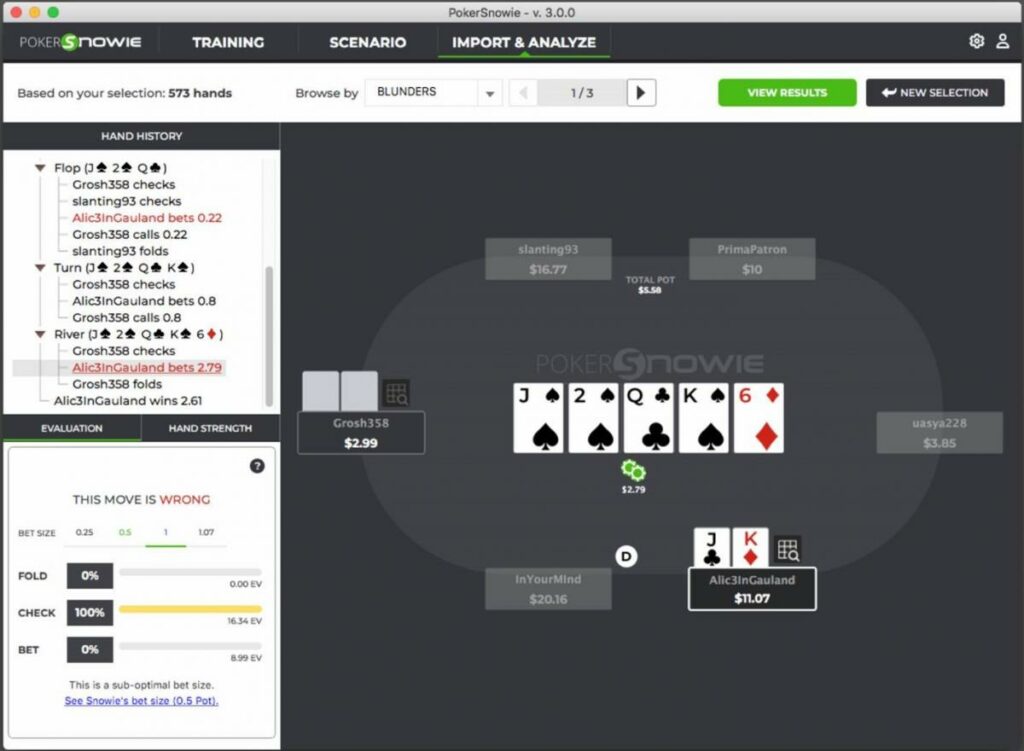
Before the explosion of solver software, one of the first widely accessible AI training tools was PokerSnowie. Launched in the mid-2010s, it used deep neural networks trained through millions of self-play hands – well before the term “solver” became mainstream.
PokerSnowie focuses on practical learning. Players can upload their hand histories, receive instant feedback on their decisions, and see clear expected value (EV) differences between their play and the AI’s recommendations. It acts like a digital sparring partner: tough, consistent, and relentlessly objective.
For many pros and serious amateurs, Snowie bridges the gap between solver theory and live decision-making. Its strength lies in teaching players to internalise balance and discipline – not just memorise outputs. Whether you’re analysing cash game sessions, simulating tournament spots, or testing new lines, Snowie remains a powerful companion for mastering modern poker strategy.
Solvers, Simulations, and the Age of the Poker Algorithm
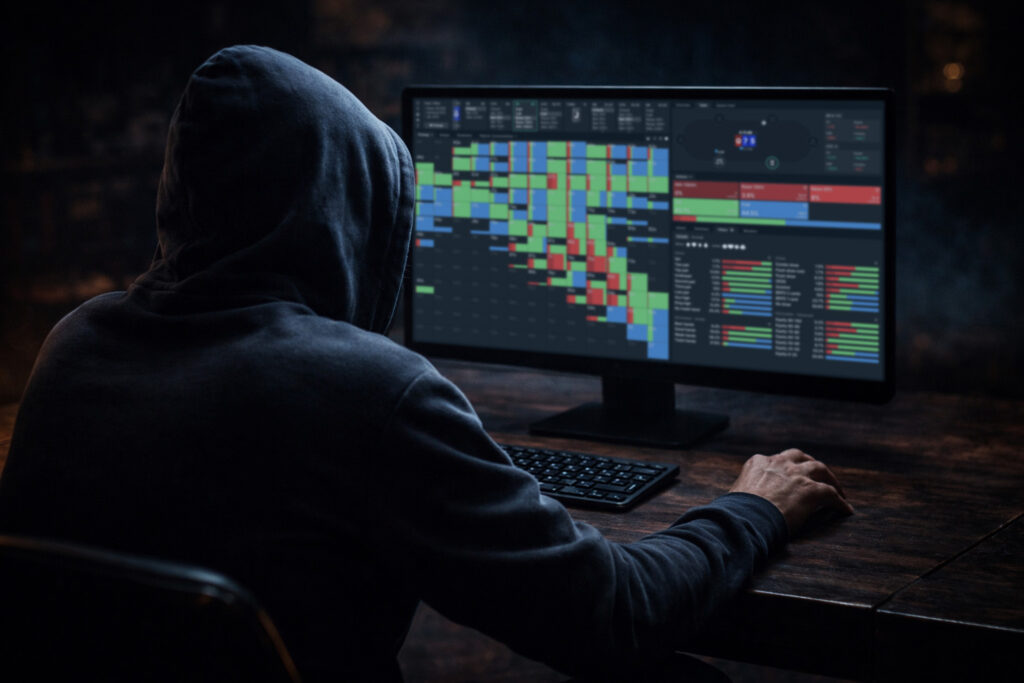
The ripple effect from Libratus and Pluribus birthed a new generation of poker solvers – software tools that model Game Theory Optimal (GTO) strategy. Programs like PioSOLVER, GTO+, and Simple Postflop allow players to simulate nearly any poker situation and compute the mathematically balanced responses.
Today, serious professionals treat solvers as essential as chips and cards. A top online grinder may analyze hundreds of spots daily, studying solver outputs to refine their play. These tools don’t just teach what to do – they reveal why.
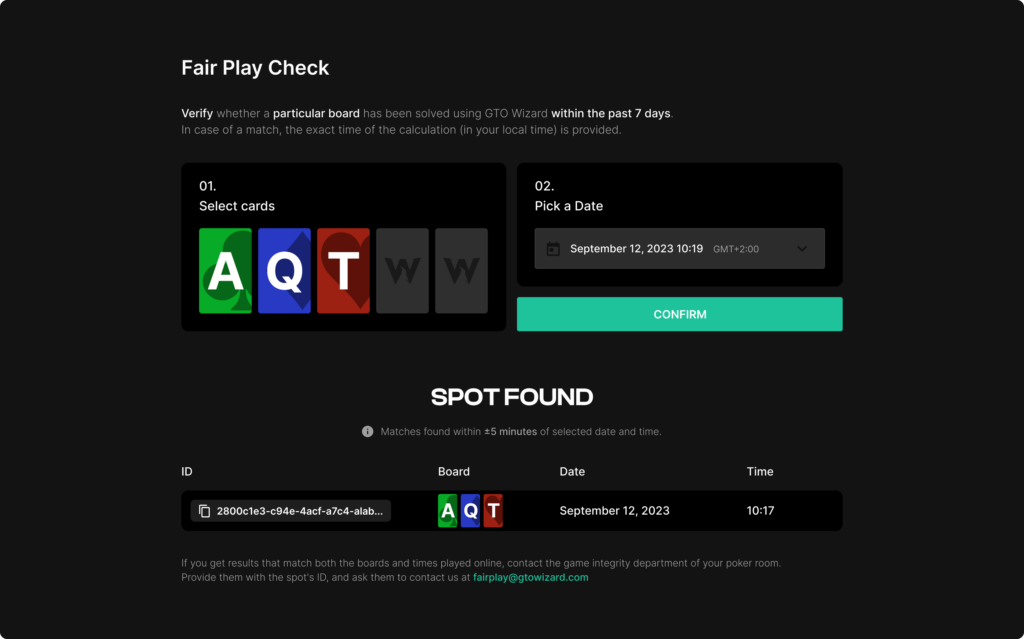
But there’s a darker side to solver technology. As solvers became more accessible, so did real-time assistance (RTA) – software that tells players, mid-hand, what the “perfect” move is. Using solvers during live play is strictly prohibited, yet enforcement is notoriously difficult. Detecting RTA use requires sophisticated behavioural analysis – something AI is now helping with on the other side of the table.
AI Policing AI: The New Front in Game Integrity
Modern poker platforms rely heavily on AI-driven security. Behind every digital hand dealt, machine learning models monitor betting patterns, reaction times, and click sequences – looking for anomalies that suggest collusion, bot activity, or RTA use.
Companies like PokerStars and GGPoker have invested millions in these anti-cheating AIs, building models that can distinguish human decision rhythms from algorithmic precision. These systems don’t just ban cheaters – they help maintain trust in an ecosystem that’s increasingly digital and data-driven.
Ironically, AI has become both the problem and the solution.
Data Is the New Edge
Every hand of poker generates data: betting sequences, timing tells, stack sizes, win rates, and opponent profiles. Modern players collect and analyse this data obsessively. But AI is taking this analysis to a new level.
Advanced training tools now use neural networks to scan millions of hand histories, identify statistical leaks, and generate personalised study plans. Imagine an AI coach that watches your every move, compares it to solver data, and tells you exactly how you deviate from optimal play.
That’s no longer science fiction. Several platforms already offer this kind of intelligent feedback loop – turning AI into the ultimate poker tutor.
Soon, this might evolve into AI-powered adaptive training. Picture an app that simulates opponents modelled after your actual rivals, learns your weaknesses, and dynamically adjusts difficulty. Instead of watching hours of hand replays, players could practice against synthetic opponents designed to expose their precise strategic gaps.

The Next Wave: Poker in Virtual and Augmented Reality
While AI refines the brain of the game, VR and AR technologies are reinventing its face.
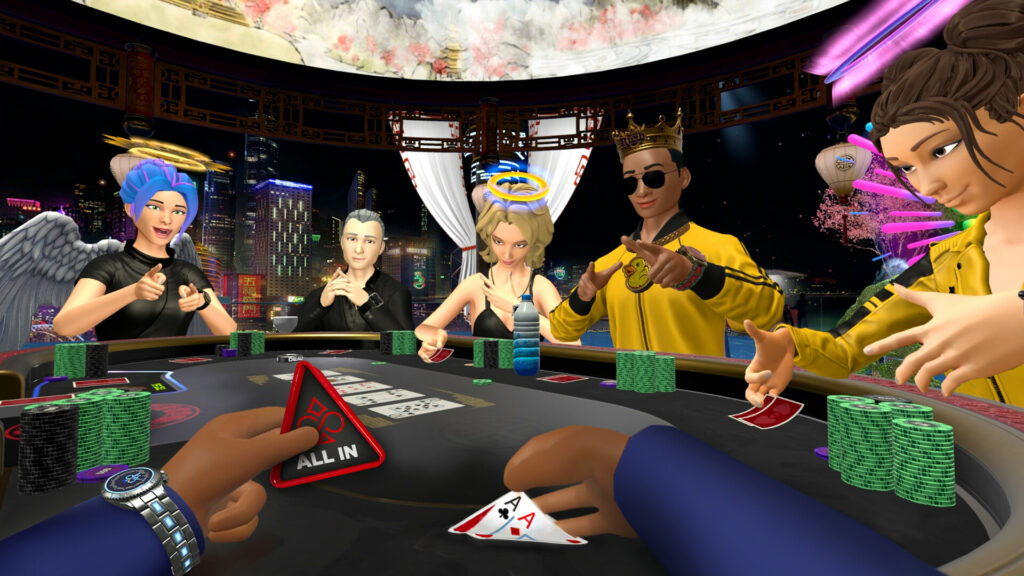
VR poker platforms – like PokerStars VR and CasinoVR – already allow players to sit at digital tables, interact via lifelike avatars, and even read virtual “tells.” Motion tracking and spatial audio add a layer of realism that mimics live play far better than 2D online games.
The next evolution could merge AI and VR, creating dynamic environments that respond to player behaviour. Imagine:
- Virtual dealers that analyse table talk and adjust their commentary.
- AI-generated opponents indistinguishable from human players.
- Real-time strategy overlays visible through AR glasses during live tournaments.
We’re moving toward a future where the poker table itself becomes intelligent – an interface between human intuition and digital insight.
Blockchain and Transparency: Solving the Trust Problem
Poker’s digital transformation has also revived an old concern: trust. In online play, you can’t see your opponents – or the cards being shuffled. How do you know the game is fair?
Enter blockchain-based poker. Decentralised platforms like Virtue Poker and CoinPoker use smart contracts to ensure verifiable randomness and transparent pot distribution. Players can audit game outcomes without relying on a centralised authority. Combined with cryptographic identity verification, blockchain could reduce fraud, collusion, and multi-accounting.
As AI continues to push poker deeper into the digital realm, blockchain offers something equally important: verifiable fairness.
The Ethical Tightrope: When Assistance Becomes Cheating
As AI becomes a staple of poker study, the boundary between preparation and unfair advantage grows hazy. Most professionals today rely on solvers for post-game analysis – but what happens when those same solvers operate in real time?
Poker sites have begun implementing strict anti-RTA policies, banning accounts caught using decision aids during play. But technology always runs ahead of regulation. Some players use subtle “helper” apps that offer advice indirectly – displaying colour-coded hints or equity estimates.
At the same time, AI assistants like ChatGPT are being integrated into coaching tools and study groups. It’s easy to imagine a near-future where conversational AI acts as a live, adaptive poker strategist whispering advice through an earpiece.
So where’s the line? Perhaps the answer will mirror other competitive domains, like esports or chess – where “AI assistance” outside of live competition is encouraged, but any real-time influence is banned. Still, as AI becomes seamlessly integrated into everyday tools, enforcing that distinction will get harder.
The Human Element: Intuition, Emotion, and the Unsolved Edge
For all its precision, AI lacks one thing poker thrives on: emotion.
Humans bluff not just for mathematical reasons but to send messages – to manipulate perception, to act out of frustration, to establish dominance.
AI plays a perfect strategy, but poker is often imperfect by design. The best human players exploit others’ emotional imbalances, detect fatigue, and read subtle physical cues no solver can perceive.
That’s why, despite the rise of machines, poker remains deeply human.
AI may compute the optimal decision, but only people can decide when to ignore it.
The Next Five Years: What’s Coming
Let’s fast-forward to 2030.
Here’s how the poker landscape could look if current trends continue.
1. AI-Enhanced Players Dominate
Pros will use AI-powered personal assistants to simulate tournament scenarios, analyse rivals, and refine decision trees. The next generation of champions will be AI-hybrid competitors – humans who understand both intuition and algorithmic equilibrium.
2. Real-Time Strategy Analytics
In major televised events, spectators might see GTO probabilities and bluff frequencies displayed in real time, similar to sports analytics overlays. AI commentary could explain complex plays instantly, democratising poker knowledge.
3. Personalised AI Coaching
Training platforms will merge solvers with conversational AI. Instead of static lessons, players will get interactive, on-demand coaching that adapts to their exact skill level and tendencies.
4. Regulatory Frameworks for AI in Gaming
Expect global gaming authorities to establish clear boundaries for AI use – defining what counts as fair assistance, what constitutes cheating, and how platforms must monitor compliance.
5. Synthetic Opponents and Infinite Practice
AI-generated opponents modelled after real player archetypes will allow near-limitless practice. Imagine training against a digital “Phil Ivey” or “Fedor Holz” clone built from anonymised historical data.
6. Augmented Reality Tournaments
Live poker could integrate AR layers showing pot odds, hand histories, or opponent stats – an evolved form of the “heads-up display” once banned online.

The Meta-Game: AI as the Ultimate Mirror
At its core, poker has always been a reflection of human nature – our greed, fear, and curiosity distilled into cards and chips. AI is amplifying that mirror. It forces players to confront their biases, measure their intuition, and evolve beyond gut instinct.
In a way, AI is making poker more human, not less. Because when machines reveal the game’s mechanical perfection, what’s left for us is the artistry – the decisions that defy logic yet still win.
The Future Is Human + Machine
The story of poker and AI isn’t one of replacement – it’s one of collaboration. AI doesn’t destroy the game; it deepens it. It gives players tools to understand complexity, platforms to ensure fairness, and opportunities to explore strategy at levels once unimaginable.
The champions of the future won’t just think like computers -they’ll know when not to. They’ll merge analytical precision with emotional intelligence. They’ll play the cards, the players, and the algorithms.
Poker has always been about adaptation. And as AI reshapes the felt, one truth remains unchanged:
In the end, it’s still you, your opponent, and the courage to make a call in the dark.