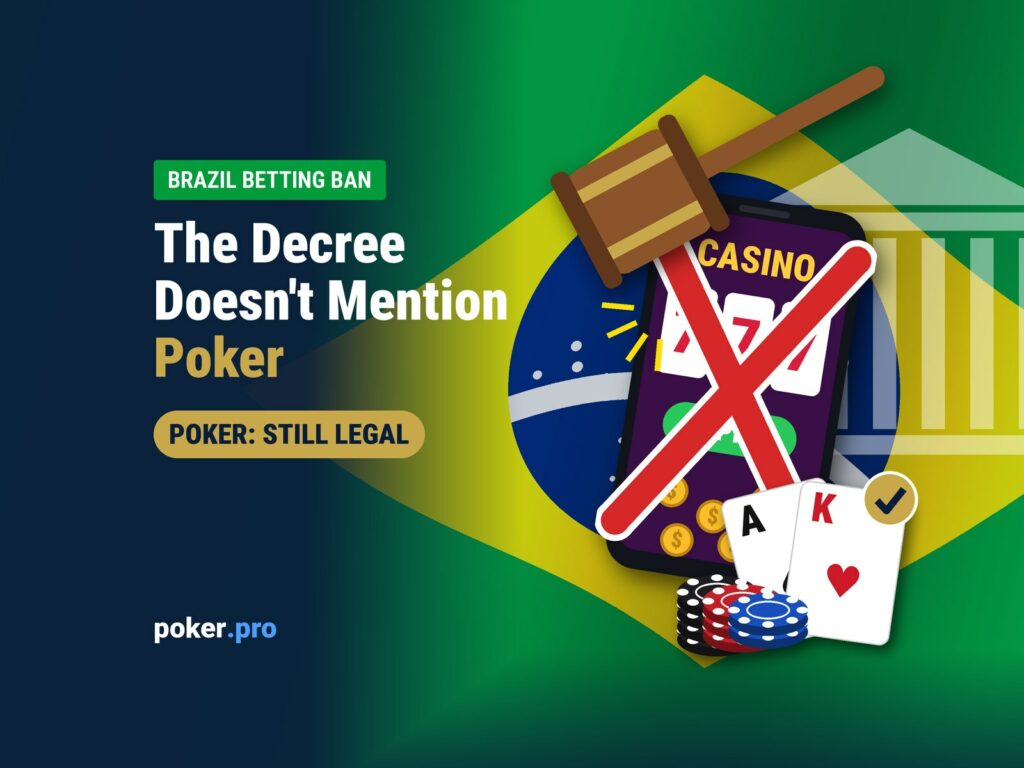
Brazil banned online betting on September 25, 2026. The decree does not mention poker. That is not an oversight. It is the result of a legal architecture that has classified poker as a skill game for years, placing it outside the fixed-odds lottery framework the government just abolished. For the country’s estimated 10 million online poker players and for operators like GGPoker, PokerStars and WPT Global, the answer to the question everyone should have been asking is this: nothing changes.


What Lula Signed
Medida Provisória Nº 1.394, published in the Diário Oficial da União on September 25, bans “the exploitation, offering, brokerage, and advertising of loterias de aposta de quota fixa” (fixed-odds betting lotteries) in physical and digital formats across Brazil, effective immediately. Advertising stops now. No new deposits from September 25. Websites and apps must be offline by October 6. Players have until October 5 to withdraw funds. All licenses are extinguished within 30 days. No refund of the R$30 million each operator paid to obtain those licenses.
The decree is a Medida Provisória, not a permanent law. Congress has 120 days to approve, amend or let it lapse. If no action is taken it expires. Companion criminal legislation proposes 4-6-year prison terms for operators who continue operating and 2-4 years for payment processors who continue processing bets. According to iGaming Business, operator compensation demands could reach R$120 billion. The National Association of Games and Lotteries has already announced legal action to overturn it.
The context matters. Brazil launched a licensed sports betting market on January 1, 2025. Approximately 90 operators paid R$30 million each for licenses running through 2029. Within months, the data coming in was catastrophic: R$37 billion in player losses in 2025 alone, a 137% rise in gambling-related mental health demand, 1.8 million Brazilians driven into debt, welfare recipients spending 27% of a single month’s Bolsa Família payments on bets. Lula, who had championed the regulatory framework, reversed course nine days before the first round of the October 4 presidential election. Senator Flávio Bolsonaro called it an “electoral measure.” The polls showing overwhelming public support for the ban suggest he is not entirely wrong.


Why Poker Is Not in the Decree
Poker was never part of the framework being abolished. That is the answer, and it has been the answer for years.
Law 14.790/2023, the legislation that created Brazil’s sports betting licensing regime, does not address poker. Ordinance SPA/MF No. 1,207/2024, the implementing regulation that defined the scope of that regime, explicitly states that skill-based games “do not fall under the category of virtual events in online fixed-odds betting.” Brazil’s Secretariat of Sports classifies poker as a sport. Legal 500’s Brazil guide describes poker as “lawful and unregulated as gambling,” meaning neither prohibited by the gambling statutes nor brought within the modern betting framework. The Brazilian government’s own position, consistently held, is that poker is a game of skill rather than a game of chance, and therefore exempt from casino and sports betting restrictions.
MP 1.394 targets fixed-odds lotteries. Poker is not a fixed-odds lottery. The decree’s silence on poker is not an ambiguity to be resolved. It is the law working as designed.
One complication is worth flagging. A March 2026 report in Yogonet revealed that the SPA had been, in practice, applying casino-style licensing requirements to online poker operators: RNG audits, facial recognition, a 12% GGR tax, a 15% player winnings tax. If any poker operator obtained a fixed-odds betting license under that framework, that license is technically extinguished alongside the rest. The paradox is real: an operator that voluntarily entered the regulatory system is worse off today than one that never did. But this is a licensing anomaly, not a prohibition on poker. The underlying activity of offering poker as a skill game remains lawful regardless of what happens to the licenses.
Where Operators Stand
PokerStars is the most complicated case. It holds a Brazilian license through Betfair Brasil LTDA. but restructured in December 2024 to become a poker-only service in Brazil, surrendering sports betting and casino products ahead of the January 2025 market launch. Its license covers a framework now being abolished. Its product is a skill game the decree does not reach. Those two facts sit in tension, and how that tension resolves will depend on how Brazilian courts and regulators interpret the license extinction provisions when applied to an operator whose actual product was never in scope.
For GGPoker, WPT Global, partypoker, 888poker and Americas Cardroom the situation is cleaner. None appear on the SPA’s licensed operator lists, meaning they operate as international platforms entirely outside the licensing regime that MP 1.394 abolishes. Nothing in the decree reaches them. All are continuing to accept Brazilian players with no reported disruption.
The BSOP, Brazil’s premier live poker circuit run by PokerStars Live, continues operating across multiple Brazilian cities, expanding its schedule and introducing new high-roller and specialty events in 2025-2026. Traditional casinos have been illegal since 1946. Live poker operates under the skill-game framework and has not been subject to enforcement action.
What Brazilian Players Face
Nothing criminal, nothing new. There are no statutes criminalizing a Brazilian citizen for playing on an international online poker site, and MP 1.394 does not create any. The enforcement architecture that had been building since October 2024, PIX blocking and domain takedowns, was aimed at unlicensed gambling and casino operators. Of the 15,463 illegal websites taken offline in that period, none were major international poker platforms. PIX deposits to poker sites have continued without reported disruption.
Taxation is unchanged. Players on unlicensed international platforms self-declare winnings at progressive income tax rates up to 27.5%. Players on licensed platforms had been paying a flat 15% on net winnings. If PokerStars’ licensing status shifts to unlicensed because its license is extinguished, the differential narrows and everyone ends up in the self-declaration category. The practical impact for most Brazilian poker players is zero.
Why It Matters to Poker
Brazil is not a small market. It has been called the largest untapped poker market in the world. Ten million players, Portuguese-language infrastructure built out by every major operator, a live circuit in the BSOP that rivals anything in Europe. The destruction of the licensed gambling framework around poker does not affect poker’s legal status, but it changes the environment in which poker operates.
The most significant near-term implication is not legal but structural. The 120-day congressional window is where everything gets decided. Three outcomes are possible. Congress approves the ban as written: poker remains unaffected, the surrounding gambling market stays dark, and the unregulated-but-lawful status quo continues indefinitely. Congress lets the decree lapse: the licensed market could reconstitute, and a formal poker licensing framework might eventually emerge from the rebuilt regulatory architecture. Congress amends the decree toward the casino-only prohibition already circulating as Bill 2,258/2026: sports betting survives in some form, and the path opens for regulated poker to enter alongside it.
In any of those three scenarios, poker is the one product that survives. It survives because Brazilian law placed it outside gambling regulation before any of this started. The government banned betting, forgot to mention poker, and the omission was not accidental. That is the most important fact in this story, and almost no one has written it yet.
FAQ
Article originally produced at poker.pro.