Nobody truly understands multiway strategy, which is surprising because of how important it is. If you play a lot of live poker, the pots regularly go three, four, or even five-way, and nobody knows what they are doing.
The biggest single error players make multiway is bluffing too much. Specifically, continuation betting too much.
Most players playing today came up when simply c-betting a lot would print money, before counter-strategies and defence frequencies were devised. It’s a mistake to blindly c-bet all the time heads-up, it’s a much bigger mistake to do it multiway, and a terrible idea to do it with a stone-cold bluff.
So here is the most important takeaway we have learned from the solvers.
The more players in the pot, the less often you should bluff.
In theory, you are just going to run into made hands more often. In practice, in soft live games and low-stakes online tournaments, it’s hard to expect one player to fold, and even tougher to expect multiple players to fold.
This doesn’t mean don’t bluff; however, you just have to change how you bluff.

Heads-up, your bluffs should be weak holdings, because it’s such a great result to take it down with the bottom of your range. So we bluff with things like gutshots. Hands we can easily fold if reraised. But multiway, we are more likely to be called, so our strategy changes.
When you do bluff, your bluffs need to be drawing to something very strong. You want very strong semi-bluffing hands to nut straights and nut flushes, for example. Basically, the hands that can reliably beat more than one value hand.
Poker is much more honest and oriented around value multiway; it is one of the things that makes multiway strategy simpler to execute than most people realise.
Having said that, there are spots where you can really ramp up your bluffing, which is on the river when all the opponents have capped themselves. What I mean by this is that they have ‘capped their range’ and demonstrated they are unlikely to have value hands, because all the value hands would have bet on the flop or turn.
A hand like top pair or better would have bet before the river, especially if there are draws on the board. So when they don’t bet either street, you can get away with bluffing a lot more often.
Old school players have known this forever; these are the ‘Orphan Pots’ that nobody seems to want. You can play very exploitatively in these spots.
But other than that, reduce how often you bluff, and make sure you are drawing to a very strong hand when you do.
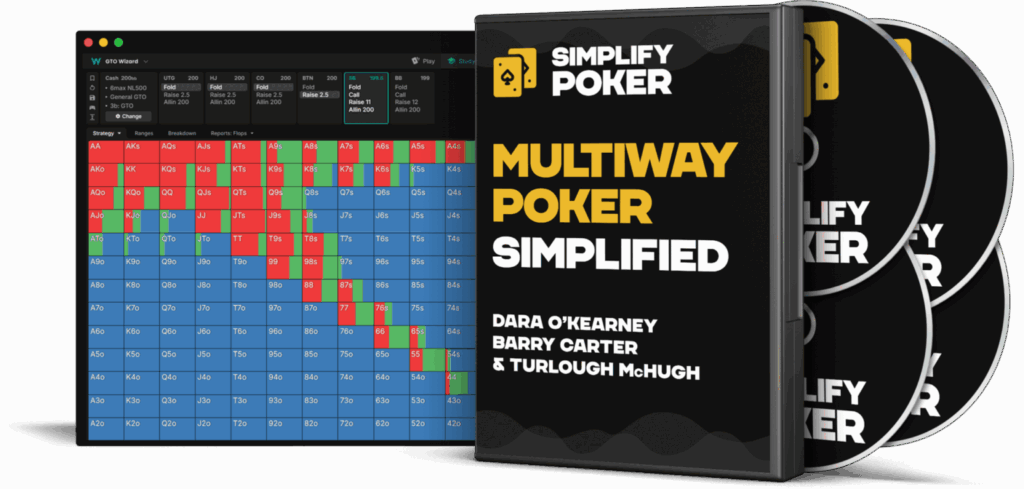
Dara O’Kearney is the lead coach at Simplify Poker. If you use code POKERPRO you can get 20% off all of their products, including their new course Multiway Poker Simplified.

Dara O’Kearney is a professional poker player from Ireland with a longstanding reputation as a specialist in ICM and solver technology. He has won millions both live and online, including winning over $1 million in satellites alone. He is best known in recent times for being a coach to both amateur players and elite professionals, as well as his six best-selling poker books. He is sponsored by WPT Global and is the co-host of The Chip Race Podcast.