Understanding Positional Equity – the Missing Link in Hand Evaluation
Most poker players think of hand equity as a fixed number – as if once you know AKo has 56% against QQ, the story ends there. But in real play, equity is never static.
The moment position enters the equation, the math changes. The same two hands can have different realised outcomes depending on who acts last.
This is what we call Positional Equity – the ability to convert your hand’s theoretical equity into actual chips.
- Read more: The Out-of-Position River Stab: Myth or Weapon?
- Read more: Raise the Right Hands: A Field Guide to Linear & Polar 3-Bets
The Hidden Variable: Realised Equity
The cards you hold give you theoretical equity – the raw math if both players saw all five cards to showdown. But poker isn’t played face-up. When you’re in position (IP), you get to see what your opponent does first. That means you control pot size, bluff timing, and showdown value. When you’re out of position (OOP), you’re always reacting – often forced to check, fold, or make uncomfortable guesses.
The result? The same hand has different effective equity depending on the position.
Let’s Look at This Example: TT vs. KQo – Same Hands, Different Story
Let’s take a classic matchup: pocket tens versus king-queen offsuit.
If both players go all-in preflop, the math is simple:
- TT ≈ 55% equity
- KQo ≈ 45% equity
But when we don’t go all-in – and we actually play the hand – position flips the script.
Case 1: TT Out of Position vs. KQo In Position
(Example: UTG opens, BTN calls)
| Street | What Happens | Effect on TT’s Equity |
|---|---|---|
| Preflop | TT has ~55% raw equity | Baseline |
| Flop | Overcards appear on 60%+ of boards – TT must often check/fold or play passively | Equity under-realized |
| Turn/River | KQo uses position to value bet or bluff efficiently | TT folds too often |
| Result | TT’s realized equity drops to ~46–47% | Loses ~8–10% vs raw equity |
Even though TT is ahead “on paper,” KQo gets to control the narrative. Position turns KQo’s 45% into something closer to real-world parity.
Case 2: TT In Position vs. KQo Out of Position
(Example: BTN opens, BB calls)
| Street | What Happens | Effect on TT’s Equity |
|---|---|---|
| Preflop | Same ~55% raw equity | Baseline |
| Flop | TT chooses when to bet, check, or pot control | Maximises realisation |
| Turn/River | Can value bet safely and avoid overcommitting | Keeps EV high |
| Result | TT’s realised equity rises to ~58–59% | Gains +3–4% from position |
In this mirror scenario, TT’s advantage becomes decisive. By acting last, the player with TT captures a much higher share of their theoretical edge.

Why Position Changes Equity
Position gives you three built-in edges:
- Information – you see your opponent act first, so you make better, more profitable decisions.
- Pot Control – you decide whether to grow or shrink the pot based on hand strength.
- Pressure – you can bluff more effectively and value-bet thinner, forcing OOP opponents to overfold.
This means raw equity ≠ realised equity. Even if a solver shows two hands close in preflop strength, the in-position player tends to capture more of that equity over time.
Realized Equity Comparison Table
| Matchup | Raw Equity | In Position | Out of Position |
|---|---|---|---|
| TT vs KQo | ~55% (TT favoured) | TT ≈ 58-59% | TT ≈ 46-47% |
| AJo vs 88 | ~53% (AJo favoured) | AJo ≈ 56% | AJo ≈ 45% |
| 76s vs AQo | ~39% (76s behind) | 76s ≈ 43-44% | 76s ≈ 35-36% |
Estimates based on solver output trends for 100bb play.
Why This Matters for You
For recreational and intermediate players, understanding positional equity is like putting on glasses after years of blurry vision.
It explains:
- Why marginal OOP hands lose money even if they “look good on paper.”
- Why looser button opens are profitable even with hands like Q9s or 65s.
- Why flatting strong but medium hands (like TT) in early position often underperforms shoving or 3-
- betting.
Position magnifies your wins and cushions your losses – or flips that around if you ignore it. Understanding positional equity means understanding how the same hand transforms depending on where you sit.
Hand equity is not static. Your 55% equity doesn’t mean much if you can only realise 45% of it.
Out of position = equity discount. Theoretical strength weakens when you’re forced to act first.
In position = equity boost. You see more information and can play more accurately.
Always think in context. Hand value + position + formation = true EV.

Next time you’re tempted to defend that decent-looking hand OOP because “it’s ahead,” ask yourself: “Can I realise my equity here – or am I just playing blind?” Because in poker, position isn’t just power – it’s equity.
Once you start seeing poker through the lens of positional equity, you realise that the very best players aren’t just GTO wizards – they’re artists at extracting and denying equity through position.
Here are a few elite players who exemplify this concept – and whose play is highly worth studying if you want to deepen your understanding of positional equity and how it truly shapes winning poker:
Linus Loeliger (LLinusLLove) – The Solver in Human Form

Best for: Technical precision and balance. Linus is probably the clearest modern example of how to maximise positional equity. He doesn’t just “play in position” – he builds his entire strategy tree around it.
- From the button and cutoff, he maintains insane positional pressure with small c-bets and range merges that squeeze every drop of realisation.
- OOP, he neutralises disadvantage with disciplined checking and well-timed counterattacks (turn probes, delayed XR).
Study: Watch his $25/$50 and $50/$100 online sessions; focus on how he maintains pot control IP and varies bet sizing to keep opponents’ equity capped.
Stephen Chidwick – The Positional Purist
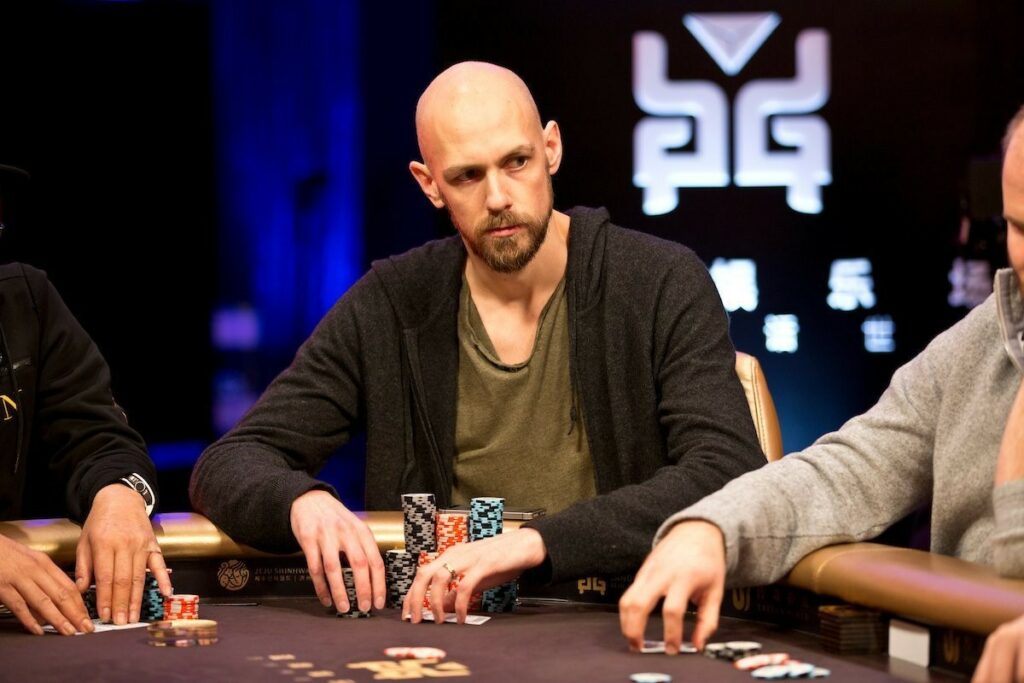
Best for: Live and multiway tournament dynamics. Chidwick’s superpower is turning position into initiative – even when he starts behind. He floats, probes, and thin-bets at frequencies that force OOP players into impossible spots.
- You’ll see him extract full value from marginal top pairs IP while folding the same hands OOP.
- His ability to choose the right hands to defend IP – and abandon OOP – is textbook positional discipline.
Study: Review Chidwick’s deep runs in Triton or EPT High Rollers; note how much smaller his defending range is when OOP.
Fedor Holz – The Intuitive Edge Realiser
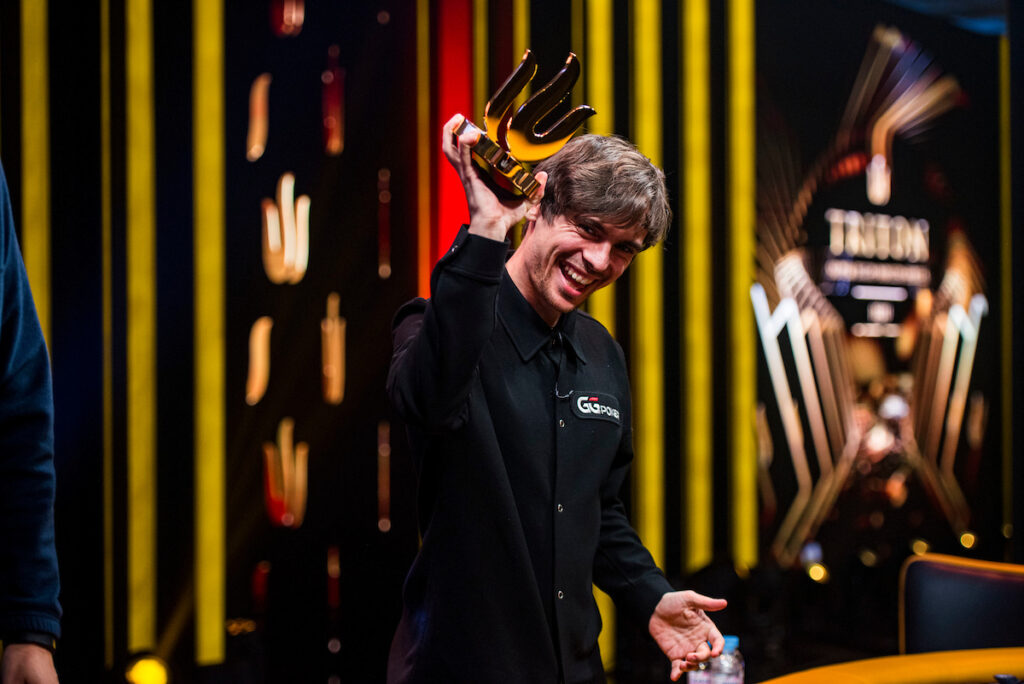
Best for: Live reads and psychological layering. Fedor’s success came from deeply feeling how positional leverage plays out.
- He used position to control emotional tempo, dictating pace and pot size.
- Even pre-solver era, he intuited that equity is only as valuable as your ability to realise it.
Study: Watch his 2016 WSOP and EPT footage – his calmness IP is the hallmark of someone who understands equity flow.