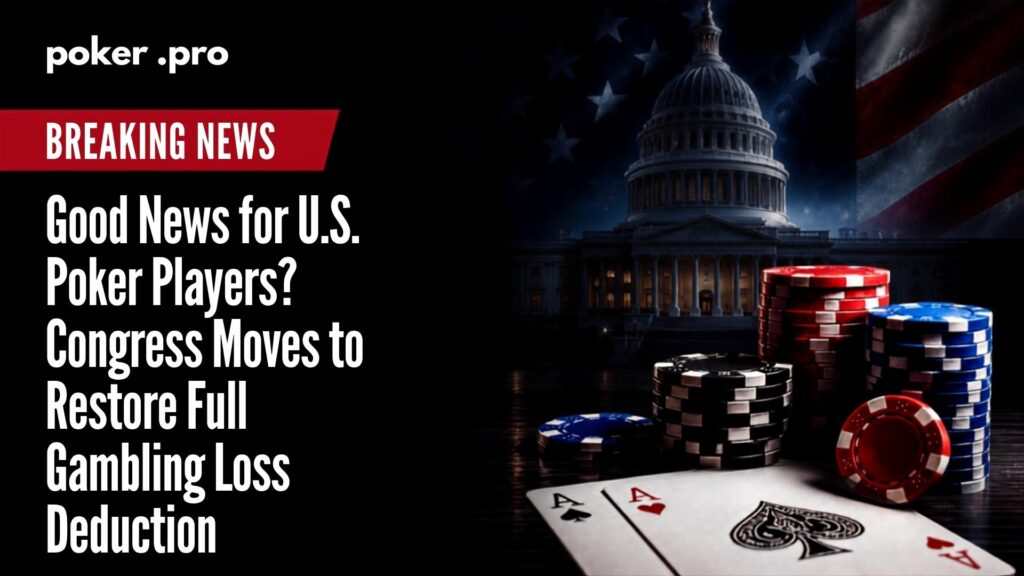
The House Ways and Means Committee is meeting this week to consider legislation that could restore the full federal deduction for gambling losses, and poker players in the United States should pay attention. The provision, tucked into a broader package called the Digital Asset Tax Certainty Act (H.R. 10357), would eliminate the 90% cap on gambling loss deductions that took effect Jan. 1, 2026, and make the restoration retroactive to the start of this tax year. Nothing is guaranteed, but it is the furthest any repeal effort has advanced since the cap became law.
What the One Big Beautiful Bill Did to Gamblers
When President Trump signed the One Big Beautiful Bill Act (OBBBA) into law on July 4, 2025, most of the attention went to the headline tax cuts. Buried in Section 70114 of the 900-plus-page bill was a change to how gambling losses are treated under the Internal Revenue Code, inserted late in the Senate version and passed largely without public debate.
For decades, U.S. tax law allowed gamblers to deduct 100% of their gambling losses against their winnings, up to the amount won. A poker player who cashed $100,000 in tournament winnings over the course of a year and lost $100,000 in buy-ins could net those out to zero and owe nothing. Starting with the 2026 tax year, that same player can only deduct $90,000 of their $100,000 in losses. The remaining $10,000 becomes taxable income even though the player did not profit. Tax professionals have labeled this phantom income because players are being taxed on money they never actually made.
The Joint Committee on Taxation estimated the provision would raise approximately $1.1 billion over 10 years, a rounding error in the context of the full bill but a real hit for recreational and professional gamblers alike. The rule applies across all legal forms of gambling, including poker tournaments, sports betting, casino games, lottery tickets, and horse racing.

Why It Hits Poker Players Hard
The phantom income problem is particularly acute for poker players because of the way winnings and losses are recorded. A casino or cardroom issues a W-2G for every significant cash-out. A player who runs deep in multiple tournaments over a year can accumulate hundreds of thousands in reported winnings even while losing money overall. Under the prior rules, documented losses could be deducted against those winnings to arrive at actual net profit. Under the new 90% cap, 10% of all losses are permanently nondeductible, creating taxable income that doesn’t reflect what the player actually took home.
For a tournament player with $200,000 in winnings and $200,000 in buy-ins and expenses over the course of a year, the new rules mean $20,000 in phantom taxable income. Depending on their bracket, that player could owe $5,000 to $7,400 in federal tax on money that does not exist. Professional players who travel internationally and play high-volume schedules face proportionally larger exposure.
Rep. Dina Titus of Nevada, whose district includes Las Vegas, warned from the outset that the change could push gamblers toward offshore platforms and unregulated venues to avoid the tax burden entirely, reducing rather than increasing federal revenue. Senator James Lankford of Oklahoma, a Finance Committee member who helped draft the provision, has publicly called the 10% reduction a fairly minor change. Players who have seen their tax exposure jump would likely disagree.
Three Bills, One Goal
Congressional pushback started within days of the OBBBA being signed. Three separate bills have been introduced to restore the 100% deduction:
- The FAIR BET Act (H.R. 4304), introduced July 7, 2025, by Rep. Dina Titus (D-NV) with bipartisan co-sponsors including Reps. Troy Nehls (R-TX) and Mark Amodei (R-NV).
- The WAGER Act (H.R. 4630), introduced July 23, 2025, by Rep. Andy Barr (R-KY).
- The FULL HOUSE Act (H.R. 6985), introduced Jan. 8, 2026, by Rep. Max Miller (R-OH) and co-sponsored by Reps. Steven Horsford and Susie Lee of Nevada, with further bipartisan support from Ways and Means Committee members.
None of the three reached a floor vote. Sen. Catherine Cortez Masto’s effort to fast-track the FULL HOUSE Act through unanimous consent was blocked by Sen. Todd Young of Indiana on procedural grounds. The House Rules Committee blocked an attempt to attach the FAIR BET Act as an amendment to the 2026 National Defense Authorization Act. The bills stalled as other legislative priorities dominated the calendar.
This Week’s Development
The picture shifted on Sept. 15 when language based on the FULL HOUSE Act was added to the Digital Asset Tax Certainty Act (H.R. 10357), a package the Ways and Means Committee is taking up this Wednesday. The provision appears on page 95 of the 98-page bill.
The text proposes eliminating the 90% limitation on the deduction for losses from wagering transactions and restoring full deductibility for taxable years beginning after Dec. 31, 2025, meaning the current 2026 tax year would be treated as if the cap never existed.
If passed as written, the restoration would be retroactive to Jan. 1, 2026. Rep. Horsford, a co-sponsor of the FULL HOUSE Act, called the inclusion a win for Nevada workers and the gaming economy. Rep. Titus, whose FAIR BET Act covers the same ground, said she encouraged her Ways and Means colleagues to push it through as quickly as possible.
Ways and Means Chair Jason Smith has previously supported restoring the 100% deduction. Placing the measure in a committee markup bill, rather than attaching it as an amendment to unrelated legislation, is a meaningful procedural upgrade. Ways and Means controls federal tax law, giving H.R. 10357 a more direct path than any prior vehicle.

Welcome bonus, $1M BBJ, and casino fun players.
Sign up through poker.pro now!
New Customers Only | 18+ | T&C Apply
Not Done Yet
Committee consideration is not the same as passage. The Digital Asset Tax Certainty Act still needs to clear Ways and Means, pass the full House, survive the Senate, and be signed into law. Each of those steps carries uncertainty. The Senate Finance Committee originally inserted the 90% cap into the OBBBA, and Lankford’s public position suggests resistance there has not evaporated.
Prediction markets tracked by Kalshi have seen more than $3.1 million wagered on whether the deduction will be restored to 100%, with traders pricing the probability at approximately 48% by April 1, 2027, essentially a coin flip. The odds lengthened meaningfully when the Ways and Means inclusion was announced, but they remain far from certainty.
For poker players who have been tracking losses and receipts carefully through 2026, the practical advice from tax professionals remains the same regardless of how this week’s committee vote goes: document everything, consult a tax adviser familiar with gambling income, and do not assume the cap will be repealed before filing. If the restoration passes retroactively, amended returns can recover overpaid tax. If it does not, players who failed to keep records will have no recourse.
The 2026 tax year is far enough along that this week’s committee markup will not be the last word. But for the first time since the OBBBA was signed, the repeal effort has a clear procedural path. That is more than could be said a month ago.