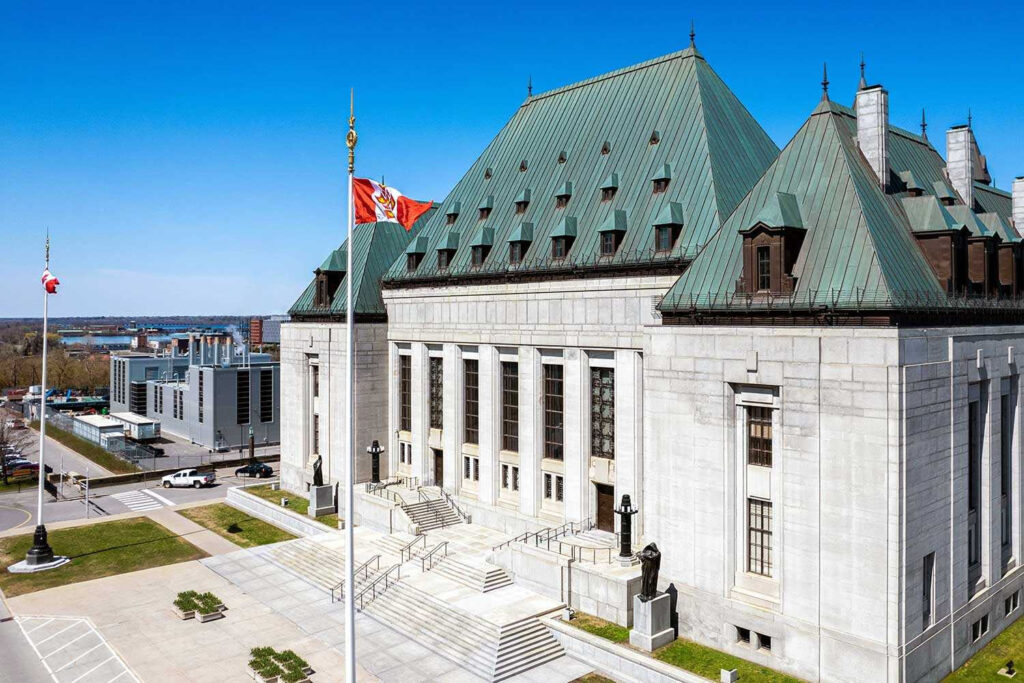
On Oct. 7, the Supreme Court of Canada will hear oral arguments in a case that could determine whether regulated online poker operators in Ontario and Alberta may legally share player pools with international markets. No ruling will come that day. The Supreme Court does not decide from the bench. The arguments presented by Alberta, Ontario, Flutter, and GGPoker’s parent company, NSUS, on one side, and a coalition of provincial lottery corporations on the other, will shape the trajectory of online poker in Canada for years. Almost no poker media is previewing it. That is a mistake.
- Read more: Alberta’s Poker Launch Looks Like Progress, But Don’t Let the Spin Fool You
- Read more: Applications Open for Alberta’s New iGaming System
How We Got Here
The case has its roots in a reference question Ontario filed with its provincial Court of Appeal in late 2024, asking whether connecting its regulated online poker market to international player pools would violate Canada’s Criminal Code. The Ontario Court of Appeal ruled 4-1 in November 2025 that it would not, provided the province continues to conduct and manage the gaming operation through iGaming Ontario. It was a significant win for the industry and removed what had been considered the primary legal obstacle to reconnecting regulated Canadian markets with the rest of the world.
The Canadian Lottery Coalition, representing British Columbia (BCLC), Manitoba Liquor and Lotteries, the Atlantic Lottery Corporation, and Loto-Quebec (which joined the appeal in April), immediately appealed to the Supreme Court. Their concern is straightforward: if Ontario is permitted to connect with international player pools, it sets a precedent that could erode their monopoly positions at home. The appeal landed at the Supreme Court in early 2026. Alberta, which launched its own regulated iGaming market in July 2026, filed to intervene in the case on Ontario’s side. Counsel for Alberta’s Attorney General Mickey Amery has confirmed it will present oral arguments on Oct. 7.


Who Is Behind Each Side
Ontario and Alberta are presenting arguments in favor of shared liquidity. Alongside them are Flutter, the parent company of PokerStars and FanDuel, and NSUS, the parent company of GGPoker, which received its Alberta operator license in August 2026 and is working toward a commercial launch in the province. The Canadian Gaming Association has also supported the pro-pooling position throughout the proceedings. On the other side, the Canadian Lottery Coalition argues that the Criminal Code requires all players in a gaming operation to be physically present within the province.
The Mohawk Council of Kahnawa:ke in Quebec initially opposed cross-border play but withdrew from the appeal in June. The court will have to determine what it means for Ontario to “conduct and manage” a game if some players are sitting in the UK or Germany.
Why Player Pooling Matters to Poker
Online poker lives and dies on liquidity. A poker room is not a slot machine or a blackjack table. It does not work with one player. The depth of the player pool determines whether cash games run at midnight on a Tuesday, whether a $215 tournament fills to 1,000 entries or limps to 80, whether a recreational player can find a game at their stakes on a weekday afternoon. The difference between a site with access to global player pools and a site walled inside a single province is not marginal. It is the difference between a product that works and one that struggles to justify itself.
Ontario learned this the hard way. Despite having 16 million people, online poker in Ontario has accounted for roughly 1% of total iGaming handle and revenue since the market launched in April 2022. The games are thin. The traffic is limited. Players who want real competition often find ways to play elsewhere. Alberta, with around five million residents, roughly a third of Ontario’s population, launched its market in July 2026 facing the same structural problem but with a smaller base to draw from. GGPoker, which runs the world’s largest online poker room internationally, obtained its Alberta license in August but has not yet launched commercially in the province, partly because the liquidity picture makes it a harder business case without shared pools.
International player pooling would change that picture substantially. Alberta and Ontario combining their pools would create a shared Canadian market of around 21 million people. It would connect those players to international operators such as PokerStars and GGPoker. That would put Canadian regulated players at tables with the rest of the world. Games would be deeper. Tournaments would be larger. The product would be more compelling. The regulated market would be more competitive against the offshore sites that currently serve Canadian players outside the legal framework, which is where much of the actual poker volume sits.
The Oct. 7 hearing is not the end of the road. Even a favorable ruling from the Supreme Court would leave unresolved questions about what operational control actually requires in a cross-border game: player protection standards, regulatory oversight, anti-money laundering protocols. Both the Ontario Court of Appeal and the industry’s own supporters have acknowledged that the technical and regulatory work of building a compliant international pool would be substantial. But a ruling that closes the door entirely would end the conversation for the foreseeable future and leave Canadian regulated poker walled inside provincial borders indefinitely.


What Happens Oct. 7
The Supreme Court of Canada does not issue same-day rulings. Oct. 7 is an oral argument hearing. Counsel for Ontario, Alberta, Flutter, NSUS and the Canadian Gaming Association will present the case for shared liquidity. The Canadian Lottery Coalition will argue against. The justices will ask questions. Then everyone goes home and waits. Supreme Court of Canada decisions typically follow months after oral arguments. A ruling in early-to-mid 2027 would be a reasonable expectation. The arguments made on Oct. 7 will frame everything that follows.
The Third Province: Why Quebec Changes Everything

The Supreme Court case becomes significantly more consequential when viewed alongside what is happening in Quebec. Canada’s second most populous province, with around nine million residents, goes to the polls on Oct. 5, two days before the Supreme Court hearing. The two parties best placed to form government have both, within the space of a week, committed to ending Loto-Québec’s online gaming monopoly and licensing private operators including PokerStars, GGPoker and others.
The Québec Liberal Party (PLQ) was first, on Sept. 9, to propose bringing private operators under the oversight of the Régie des Alcools, des Courses et des Jeux (RACJ) and tabling a bill in the first year of a Liberal mandate. PLQ leader Charles Milliard costed the measure at $310 million to $320 million annually from the 2027-28 fiscal year.
Two days later, Parti Québécois leader Paul St-Pierre Plamondon, whose party has led polling for more than a year, called the Liberal plan “brilliant” on live television and said it had gone “completely under the radar.” Plamondon has not published a costed version, but the on-air endorsement was significant enough that the host noted how rare it is for a PQ leader to agree with the Liberals.
The Québec Online Gaming Coalition, whose members include DraftKings, Entain, Flutter and Rush Street Interactive, welcomed both commitments on Sept. 10. A 2025 report by analytics firm Blask put Loto-Québec’s share of the province’s online gaming at just 17% despite the Crown corporation having operated online for more than 15 years, with the remaining 83% going to unregulated offshore platforms. The revenue case is straightforward.
For poker specifically, a regulated Quebec market would represent the third province in what could become a multi-provincial liquidity pool. Ontario and Alberta are already working toward a memorandum of understanding on shared liquidity. Quebec’s nine million residents, added to Ontario’s 16 million and Alberta’s five million, would create a domestic Canadian pool approaching 30 million people, a genuinely significant base before any international pooling is even considered. The Supreme Court’s decision on Oct. 7 will determine whether that pool can then connect to global networks. The Quebec election will determine whether a third province can join.
The election is on Oct. 5. Should either the PQ or the Liberals form government, according to Poker Industry PRO, the industry will be watching the first budget and the first legislative session for evidence that a campaign commitment becomes a bill.
FAQ
- Article originally produced at poker.pro.