








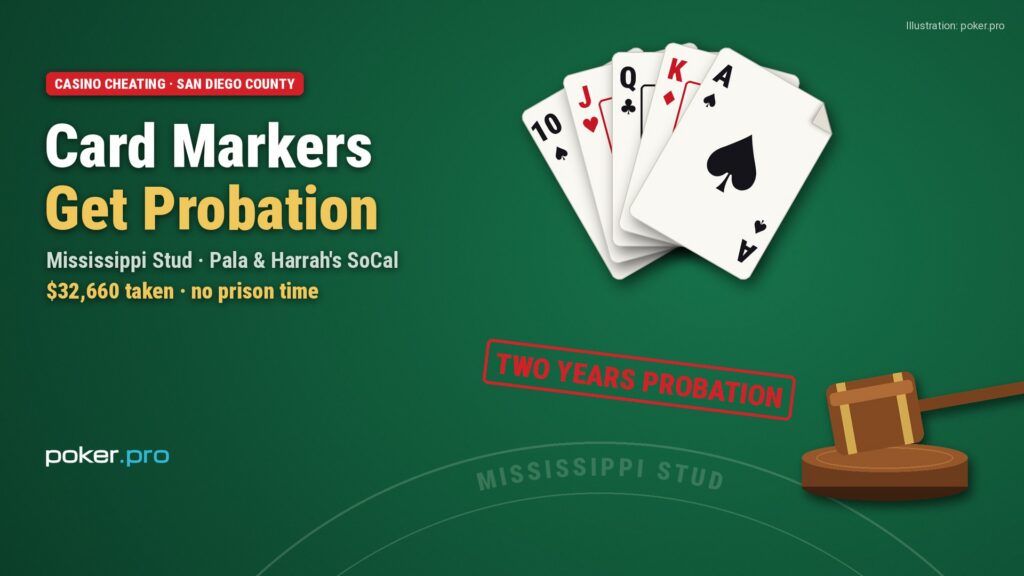
Two men accused of marking cards at two San Diego County casinos have walked away without prison time. Vaagn Galustyan, 53, and Armin Martirosyan, 54, were each sentenced to two years of probation in San Diego Superior Court on Thursday, November 19, after pleading guilty to one felony count of accessory after the fact, Casino.org reported.
The headlines called it poker cheating, but no poker players were cheated. The game was Mississippi Stud, a casino table game played against the house, and the victims were Pala Casino and Harrah’s Resort Southern California, which lost about $32,660 between them. The lesson for anyone tempted to try it is simple: the house watches its own money far more closely than anything else in the building.










- Read more: Hacking the Deck: How Technology Can Turn Poker Upside Down
- Read more: Join Poker Pro on Telegram for Breaking Tournament News and Results
Bent Corners and a Change of Clothes
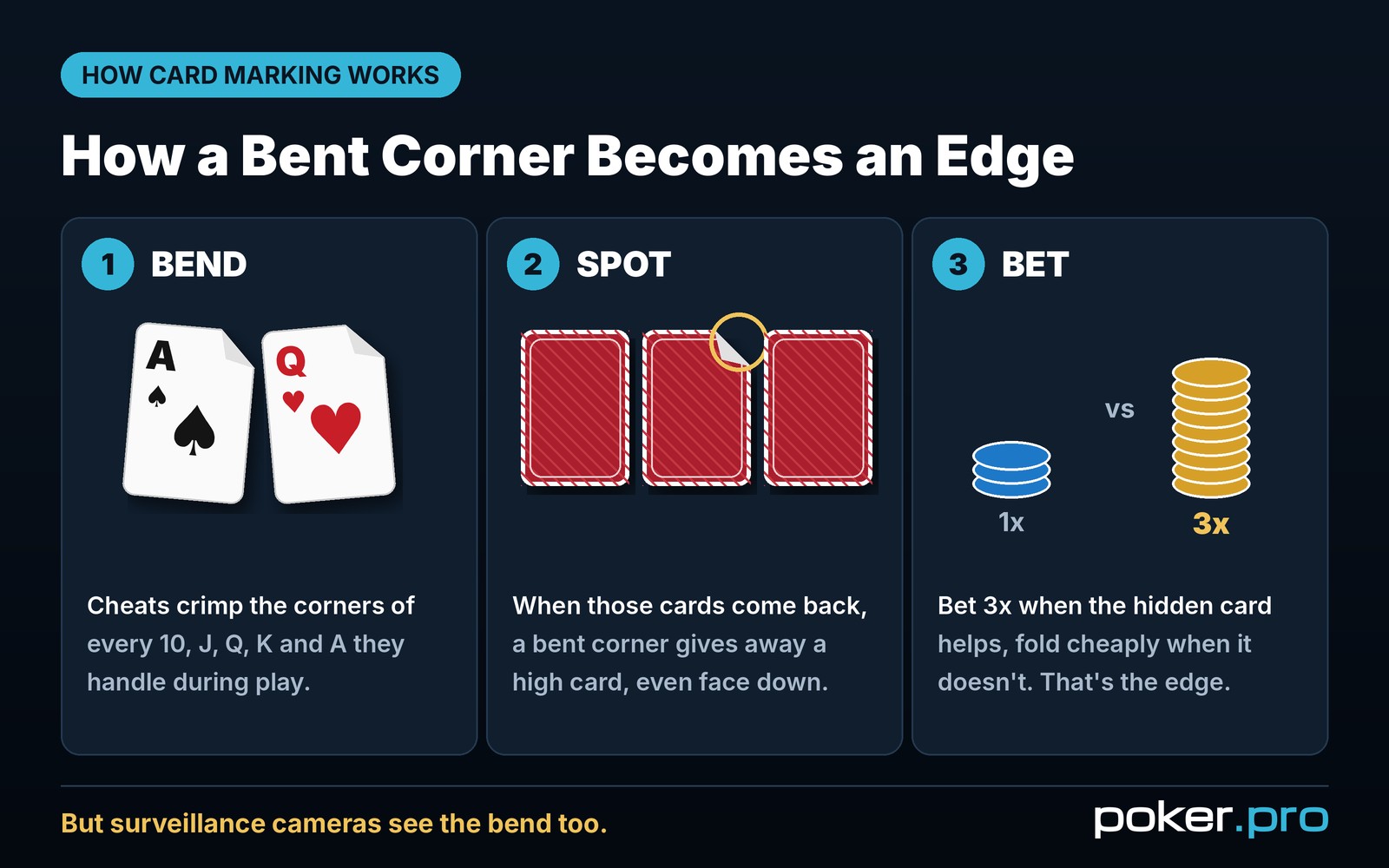
According to the San Diego County District Attorney's Office, the two men and a third person, who has not been identified, entered Pala Casino separately and then sat down together at a Mississippi Stud table. Surveillance cameras caught each of the defendants bending the corners of high-value cards, the tens, jacks, queens, kings, and aces, several times.
After a few hours, the table closed and the group left without cashing in their chips. About five hours later, in the early morning, they came back dressed in different clothes, and each went to two different cashiers to make partial cash-ins. Pala's loss came to $19,250.
The following week, prosecutors said, the men used the same method at Harrah's Resort Southern California in Valley Center and won $13,410. Both casinos are on tribal land in North County San Diego, which is why District Attorney Summer Stephan praised her office's relationships with tribal governments when the charges were announced in September 2025.
"This method of cheating at cards goes back hundreds of years," Stephan said at the time, adding that modern technology means it can be caught.
Why Marked Cards Are So Valuable in Mississippi Stud
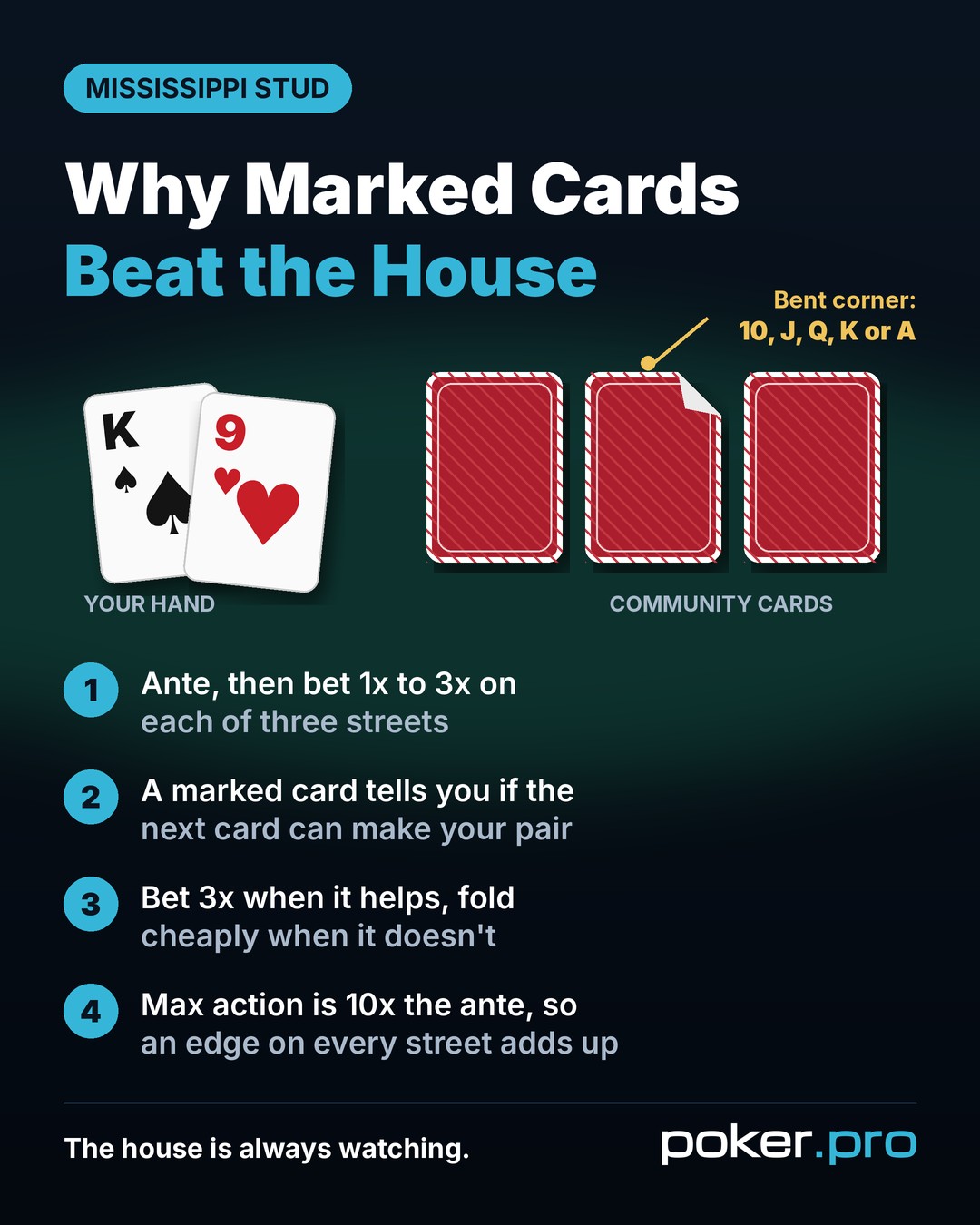
Mississippi Stud looks like poker, but it plays very differently. There is no dealer hand, and nobody at the table is playing against anyone else. Under standard rules, each player posts an ante and gets two cards face down, and the dealer puts three community cards face down in the middle. Players then bet one to three times their ante on third, fourth, and fifth street, with a community card turned over after each round, and the final five-card hand is paid out against a fixed paytable.
| Hand | Payout |
|---|---|
| Royal flush | 500 to 1 |
| Straight flush | 100 to 1 |
| Four of a kind | 40 to 1 |
| Full house | 10 to 1 |
| Flush | 6 to 1 |
| Straight | 4 to 1 |
| Three of a kind | 3 to 1 |
| Two pair | 2 to 1 |
| Pair of jacks or better | 1 to 1 |
| Pair of 6s through 10s | Push |
Standard Mississippi Stud paytable via Wizard of Odds. Paytables can vary by casino.
The casinos' publicly available materials reviewed for this article do not specify a Mississippi Stud paytable, so the table above is the standard one listed by Wizard of Odds, which puts the house edge at 4.91% of the ante, or 1.37% of the total amount bet once you account for the extra wagers. The Mississippi Stud rack card published by Caesars Entertainment, the company behind the Harrah's brand, lists the same main-game paytable, though it does not say which properties use it. The only San Diego County casino Wizard of Odds singles out is Barona, where an unconfirmed report has a straight paying 5 to 1 instead of 4 to 1. That one change would cut the house edge to about 3.76% of the ante, which shows how much a single line on the paytable matters.
That structure is exactly why marked cards are so dangerous to the house. In a normal game, you have to decide how much to bet before you see the next community card. Prosecutors said the markings were meant to help the men see what cards the dealer might have in front of them and decide how to bet on later rounds. In general terms, extra information about upcoming cards can materially improve raise-or-fold decisions. Because tens through aces can help form paying hands, information about high cards is especially valuable. In a game where players can raise or fold as cards are revealed, that information can potentially give a cheat an edge over the house. Spread over a few hours of play, the money adds up quickly.
There is big money in the side bets too. Mississippi Stud is often spread with an optional progressive wager, and Caesars' rack card lists a progressive that pays the full Mega jackpot for a royal flush and the Major jackpot for a straight flush. At Harrah's Resort Southern California, a $5 side bet on the casino's Impressive Progressive can be played at every table game on the floor. According to FOX 5 San Diego, one guest won $1,022,473 at blackjack through the Impressive Progressive, and another guest at the resort took home $1,407,630 playing EZ Baccarat in December 2022. There is no suggestion the two men chased the progressive, and the losses prosecutors described came from the main game.
From Conspiracy to Accessory After the Fact

When the men were charged, prosecutors filed two felony counts of conspiracy to commit a crime against each of them. Both pleaded not guilty at their arraignment on September 30, 2025, and faced up to three years and eight months in state prison if convicted on all charges. Deputy District Attorney Cal Logan of the Special Operations Division prosecuted the case.
Just over a year later, the case ended with a plea deal. Each man admitted a single, lesser felony count of accessory after the fact and received two years of probation, with no time behind bars. None of the sentencing reports mention whether restitution was ordered or whether either man was banned from the two casinos, and based on the available reporting, the third person seen at the table has not been publicly identified or charged.
| Date | Milestone |
|---|---|
| Sept. 30, 2025 | Galustyan and Martirosyan arraigned on two felony conspiracy counts each and plead not guilty |
| Jan. 15, 2026 | Preliminary hearing scheduled |
| Nov. 19, 2026 | Both plead guilty to one felony count of accessory after the fact and are sentenced to two years of probation |
Don't Try to Cheat the Casino
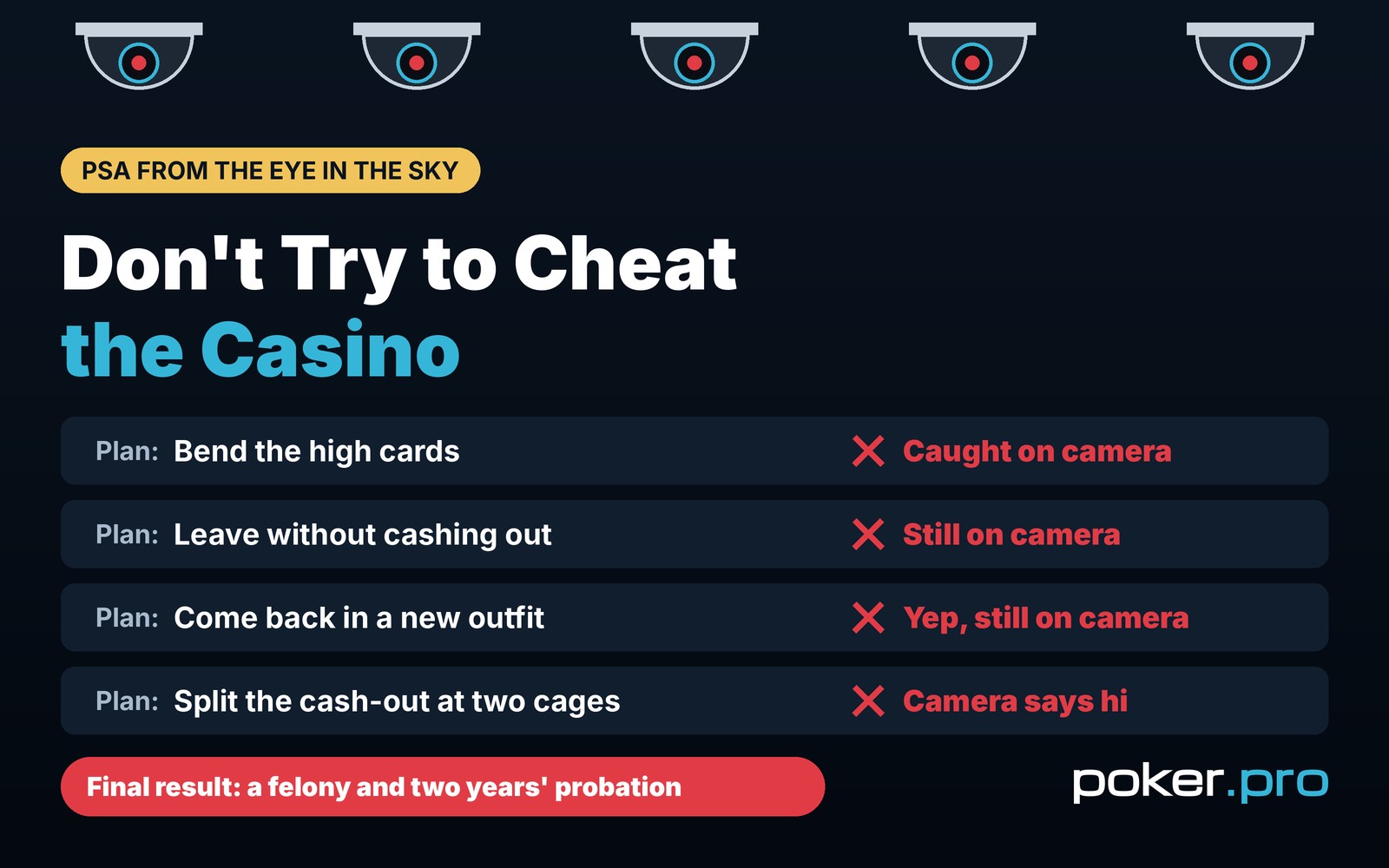
The bigger takeaway isn't how lightly these two got off. It is about how quickly they got caught. Casinos protect their own games harder than almost anything else on the property, and house-banked table games like Mississippi Stud, blackjack, and baccarat are where that protection is at its tightest. Casinos monitor their tables with surveillance cameras, and the San Diego County District Attorney's Office noted that casinos also rely on table inspections, frequent deck changes, and plastic-coated cards to spot marking.
Changing clothes and using two different cashiers for partial cash-outs did not help either. Surveillance captured the card marking, and the men were recorded coming back in different clothes to cash out.
Poker players see it the other way around. In a poker game, the house takes its rake no matter who wins the pot, so when somebody cheats, the other players lose their money. That is a big reason why player-on-player cheating, from marked decks to RFID scandals and real-time assistance online, so often comes to light through players doing their own detective work rather than the casino. When the casino's own bankroll is on the line, the response is immediate.
Even the best in the world have learned that lesson the hard way. Phil Ivey's edge-sorting sessions in 2012, at Crockfords in London and the Borgata in Atlantic City, turned into two of the biggest legal battles in gambling. Edge sorting exploits tiny flaws in the patterns on card backs, and Ivey never bent a card himself, but the UK Supreme Court still ruled in October 2017 that it was cheating, and Ivey and the Borgata settled in July 2020 after the casino won a $10.1 million judgment against him.
Galustyan and Martirosyan walked away with probation, a felony on their records, and nothing to show for it. That is about as good an outcome as anyone caught cheating a casino can hope for, and it still is not a good one.
San Diego Casino Card-Marking Case: FAQ
Was the San Diego casino cheating case really about poker?
Not in the usual sense. Vaagn Galustyan and Armin Martirosyan were accused of marking cards at Mississippi Stud, a casino table game played against the house rather than against other players. The victims were Pala Casino and Harrah's Resort Southern California in Valley Center, not poker players, which is why the poker cheating headlines are a little misleading.
What sentence did Galustyan and Martirosyan receive?
Vaagn Galustyan, 53, and Armin Martirosyan, 54, were each sentenced to two years of probation in San Diego Superior Court on November 19, 2026. Both pleaded guilty to one felony count of accessory after the fact, a lesser charge than the two felony conspiracy counts they first faced, and neither received prison time.
How much did the men win from the casinos?
According to the San Diego County District Attorney's Office, the men won $19,250 at Pala Casino and $13,410 at Harrah's Resort Southern California in Valley Center the following week. That comes to about $32,660 across the two tribal casinos in North County San Diego. A third person who played with them has not been publicly identified or charged, based on available reporting.
How did the card-marking scheme work?
Prosecutors said surveillance cameras caught the men repeatedly bending the corners of tens, jacks, queens, kings and aces at Mississippi Stud tables. In that game, players bet up to three times their ante before each face-down community card is turned over, and prosecutors said the markings were intended to help the men decide how to bet on later rounds.
How do casinos catch card marking?
Casinos monitor their tables with surveillance cameras, and the San Diego County District Attorney's Office pointed to table inspections, frequent deck changes and plastic-coated cards as common defenses against card marking. In this case, cameras recorded the defendants bending cards several times at Pala Casino, and the men were recorded returning in different clothes to cash out.
What is Mississippi Stud?
Mississippi Stud is a house-banked casino card game. Each player gets two cards and shares three face-down community cards, betting one to three times the ante on third, fourth, and fifth street. Hands are paid against a fixed paytable, from a push for a pair of sixes through tens up to 500 to 1 for a royal flush. There is no dealer hand.
- Courthouse photo courtesy of Gateman1997 / Wikimedia Commons.
- Article originally produced at poker.pro.
About the author

More Articles

Russell Westbrook’s Why Not? Foundation Holds Biggest Thanksgiving Yet After Record Poker Night

Daniel Negreanu Reveals How He Earns Money in Poker

Russell Westbrook Poker Night Raises $912,500 at Fontainebleau Las Vegas as Grigorev Takes the 2026 Title
Aussie Millions Returns in 2026 After Six-Year Hiatus

There Was Never a True Grandmaster of Poker

Leon Tsoukernik Sold King’s Casino in Rozvadov for €400 Million

Phil Ivey Wins Super High Roller Series Europe Player of the Series Title

Phil Ivey Wins SHRB Europe Event #1: $25k Short Deck For $408,000