






Most people who watch poker on TV assume the money is made in the pots. It is not. The best players in the world earn most of their income away from the table, and the people who run the games, stake the players, and book the action often do better than anyone holding cards.
Daniel Negreanu, the eight-time World Series of Poker bracelet winner and GGPoker ambassador, broke it all down in a recent episode of MasterClass’s Other People’s Business podcast, hosted by MasterClass CEO David Rogier. The conversation runs nearly an hour and covers territory that rarely gets discussed this openly: what a top pro actually earns, how private games operate, how staking and markups work, the Phil Ivey edge-sorting case, the Ultimate Bet cheating scandal, and why a handshake is still the only contract most poker deals get.
This article pulls out the most valuable parts of that conversation and adds the context that matters for anyone who wants to understand how professional poker actually works as a business.
- Read more: Baby Negreanu Is Here as Daniel Celebrates His Biggest Win Yet
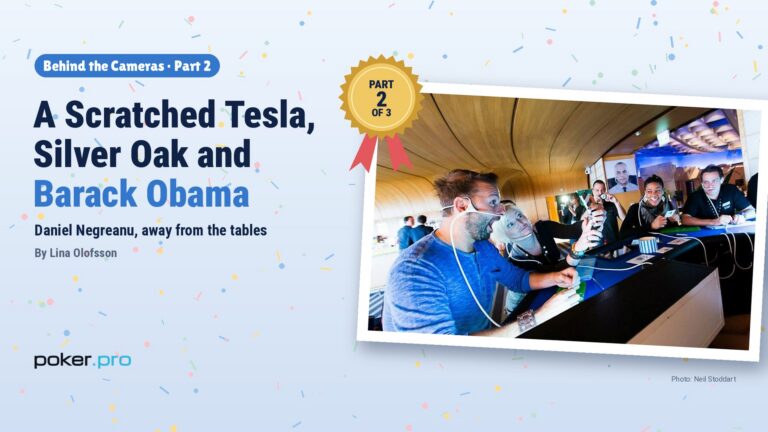
- Read more: A Scratched Tesla, Silver Oak and Barack Obama – Daniel Negreanu Behind the Cameras
- Read more: Pebel Is Changing How Poker Staking Works
- Read more: Pebel Steps Up Its Game With Hand of the Day and Easier Action Selling










Who Actually Makes Money in Poker
Negreanu's answer to this question is worth reading slowly, because most people get it wrong. The entities that reliably make money in poker are dealers (through tips and wages), casinos (through rake and fees), poker rooms (through the same), content creators and commentators (through audience monetization), and, at the top of the food chain, sponsored pros. Players who grind the highest-stakes cash games and highest-volume tournament circuits can make a living, but it is a harder, more volatile living than television coverage suggests.
The honest framing is that poker redistributes money between players. The house always extracts from the top. What is left is contested by the players, and most of that money flows toward a relatively small group of consistent winners. For every professional who is beating the game long-term, there are many more recreational players funding the ecosystem. Negreanu is explicit about this: the game is not a neutral competition between equals. It is a business in which information, edge, and financial backing determine who wins over time.
How Daniel Negreanu Actually Makes His Money
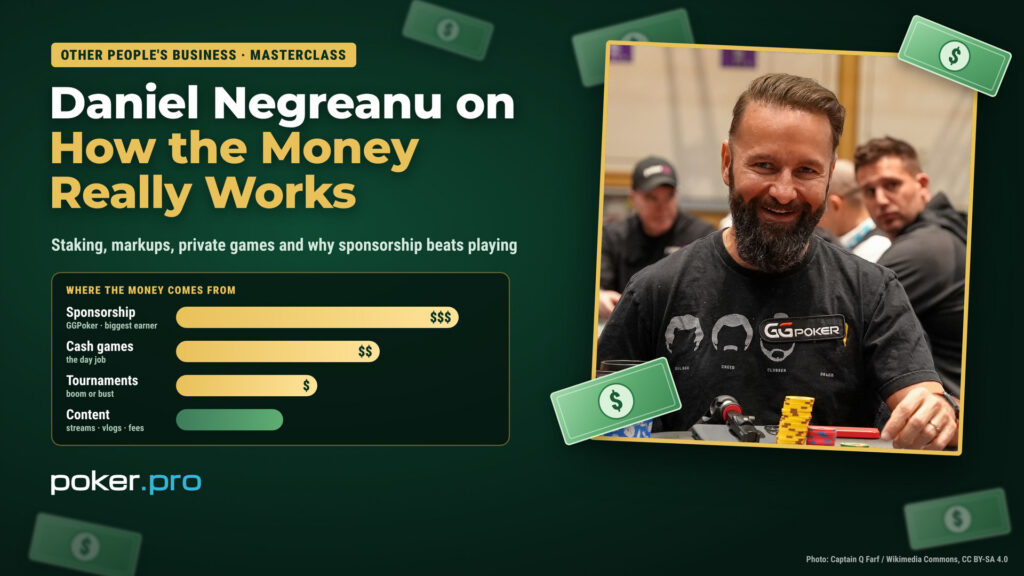
This is the most surprising thing Negreanu reveals in the podcast, and it deserves its own section. Negreanu said in the podcast that the majority of his income does not come from playing poker. It comes from his sponsorship with GGPoker. That is not unusual among elite poker players, but it is rarely discussed this directly. Sponsorships, streaming deals, content partnerships, and appearance fees are where the guaranteed money is. Prize pools fluctuate. Downswings happen. A sponsorship pays whether you win or lose.
What a top pro earns in a year from playing varies widely. The variance in tournament poker means a player can be a world-class talent and still have a losing year. Cash games are more consistent but still subject to swings. Negreanu described earning in the range of a senior corporate professional from playing, while the sponsorship income operates on a different scale entirely. The lesson for anyone thinking about poker as a career: the ceiling from playing is real, but reaching sponsorship level is a function of results, profile, and likeability that most players will never achieve.
Cash Games vs. Tournaments: A Day Job vs. a Lottery Ticket
Negreanu's framing is clear. Cash games are a day job. You show up, you play, you win or lose based on your edge over the other players at the table. If you are good enough, you grind out a consistent income over time. It is not glamorous. It is hours of concentration for modest returns, with occasional big winning sessions that can distort the average.
Tournaments are a different animal. They are boom or bust. You can play 50 tournaments and cash in a handful, then run deep in one and change your financial situation for a year. The volatility is enormous. A player who is profitable in cash games can go months without a meaningful tournament score. The appeal is obvious: the upside of a major tournament win is transformative. The downside is a long series of small losses that add up. For most players trying to build a bankroll, cash games are the more rational starting point. Tournaments are where the legends are made, but cash is where the rent gets paid.
Building a bankroll is its own conversation. Negreanu talks about starting small, moving up only when you have enough to absorb the variance of the new stakes, and treating money management as a separate skill from playing skill. Many excellent players go broke not because they cannot beat their level but because they move up too fast, play stakes their bankroll cannot sustain, or fail to separate poker money from living expenses. The business discipline of bankroll management is as important as the technical skill of playing well.
How Private Games Went Exclusive and What That Means
One of the most interesting threads in the podcast is how the highest-stakes cash games moved out of casinos and into private settings. Negreanu explains the transition through the lens of what players actually want: control over the lineup, the ability to set stakes, the elimination of rake, and an environment that suits the wealthy recreational players who fund the action.
The name that comes up most often in this context is Tobey Maguire. Maguire, the actor, became one of the most prominent operators of private high-stakes games in Hollywood, famously documented in Molly Bloom's book.
The business model of running a game is networking-intensive. You need players who can and will pay. You need a venue. You need a reputation for running a fair game. And you need to manage relationships across a group of people whose egos, wealth, and personal dynamics are all in play simultaneously. The most successful game organizers are not necessarily the best poker players. They are the best networkers and operators.
The scale of these private games is striking. Negreanu talks about games where $20 to $30 million changes hands in a single night. These are not featured in any media coverage. The players do not want attention. The organizers do not want scrutiny.
The money moves in an almost entirely informal system built on reputation and relationships. Negreanu himself largely skips the biggest games, not because he cannot play at that level, but because the financial risk isn't worth it compared to what he makes elsewhere.
Unpaid Markers, IOUs, and Why Reputation Is Everything
There are no contracts in private poker. There is no legal mechanism to enforce a debt. If a player owes you money from a game and chooses not to pay, your only recourse is reputation: you tell people, they stop inviting that player to games, the player loses access to the ecosystem. This is remarkably effective for large amounts of money. Someone who defaults on a $200,000 poker debt loses access to games where they might win millions. The incentive to pay is strong.
It breaks down at the edges. Some players are chronically slow to pay. Some disappear entirely after a bad run. The community handles this informally, through shared knowledge of who is reliable and who is not. Your word in this world is your credit rating. Negreanu is emphatic about this. He recounts running games as a teenager in Toronto and understanding early on that the trust of the people you play with is an asset worth protecting, even at high personal cost.
The best celebrity poker players, in Negreanu's telling, are the ones who treat this seriously, who pay promptly and play within their means. The worst are the ones who treat poker as an entertainment expense and then balk at the bill when it comes due.
How Poker Staking Works
Staking is one of the defining financial structures of professional poker, and it is widely misunderstood. The basic concept: a backer funds a player's buy-ins in exchange for a share of the profits. If the player wins, the backer takes their percentage. If the player loses, the backer absorbs the loss. The player gets to play without putting their own money at risk.
The complication is makeup. When a staked player loses, the losses are recorded in a ledger. The player goes into the red with the backer. Before the player can receive any profit from future sessions, they must first pay back all prior losses.
This is makeup. It creates a situation where a player can win a tournament, receive a large payout, and walk away with almost nothing because their makeup was larger than their winnings. Players who run bad for extended periods can accumulate makeup so large it effectively traps them: they cannot walk away from the staking arrangement without owing money they don't have, but they cannot get out of the hole either.
Markups are the other half of the staking equation. When a player sells pieces of themselves before a tournament, they often sell at a markup: instead of paying $1 for $1 of equity, the buyer pays $1.20 or $1.30 for each $1 of equity. The markup reflects the player's perceived edge.
A player selling at 1.3 markup is saying: I believe my expected return is high enough that paying 30% above face value is still profitable for you. Whether that is true depends entirely on the player's actual edge, which isn't always what they claim. High-profile players can command significant markups. Unknown players often struggle to sell action at any price.
Everything Negreanu describes: the makeup ledgers, the trust-based action-selling, the informal handshakes that govern tens of thousands of dollars, now has a digital equivalent. Pebel is a staking platform built specifically for the poker community that solves the trust and transparency problems that make backing players so fraught.
Players can list upcoming events and sell action publicly, backers can track makeup in real time, and deal terms are set transparently before anyone commits a dollar. With more than 300 members across 28 countries and free to join, Pebel is what the staking world has needed for a long time. The handshake system Negreanu describes isn't going away, but it now has professional infrastructure behind it for those who want it.
Is Backing Poker Players a Good Investment?
Negreanu's honest answer: it depends entirely on who you are backing. The distribution of outcomes in staking is highly skewed. Most players, even good ones, will not generate consistent profit for their backers after accounting for makeup, variance, and markups. A small number of elite players can be genuinely profitable to back over a long enough sample. The challenge is identifying them in advance.
The incentive structure of staking creates its own problems. A staked player playing with someone else's money has different risk tolerances than a player using their own bankroll. The classic principle of skin in the game matters: players who don't share in the downside may play looser, take more variance, and make decisions that aren't optimal for the backer. Good staking arrangements try to manage this, but the fundamental misalignment is never fully resolved.
Staking is also a social business. The best backing relationships are between people who know each other well, trust each other, and have aligned incentives. The worst are transactional arrangements between strangers where both sides have incomplete information about each other's honesty and competence.
Daniel Negreanu's Two-Year Losing Streak and How He Got Through It
This is one of the most valuable parts of the podcast for anyone who plays poker seriously. Negreanu talks openly about a two-year period when he couldn't win. Not a bad run of a few months. Two years. His checklist for navigating a downswing is worth taking seriously, because it comes from someone who has been at the top of the game for decades and has lived through multiple severe losing stretches.
The key questions he asks himself during a downswing: Am I playing my best game, or am I playing scared or tilted? Is my study keeping pace with the evolution of the game? Am I selecting good games, or am I sitting in games where I do not have an edge? Am I taking care of my physical and mental health, or is exhaustion or stress affecting my decisions? And, critically: is this variance or is this skill decline?
The honest version of this checklist is uncomfortable, because it forces you to consider the possibility that you are not as good as you think you are, or that the game has moved past where you are. Negreanu addresses the superstition angle too, with characteristic self-awareness: crystals, lucky rituals, and game-day routines are common among even elite players, not because they work but because having a routine creates psychological stability that is itself performance-enhancing. The ritual is not the point. The focus it creates is the point.
Phil Ivey, Edge Sorting, and the Line Between Skill and Cheating
The Phil Ivey edge-sorting cases are the most legally significant events in modern poker's relationship with casinos, and Negreanu's take on them is nuanced and worth reading carefully.
Edge sorting is a technique that exploits microscopic imperfections in the patterns on the backs of playing cards. Certain card manufacturers cut the patterns asymmetrically, meaning that if you rotate a card 180 degrees, the pattern on the back is slightly different. A player with extremely sharp vision and the ability to identify these patterns can effectively "see" high-value cards before they are revealed.
Ivey, working with partner Cheung Yin Sun, allegedly used edge sorting to win approximately $10 million from the Borgata casino in Atlantic City and a similar sum from Crockfords in London.
The legal outcomes differed by jurisdiction. The UK courts upheld Crockfords' decision to withhold Ivey's £7.7 million in winnings, characterizing his conduct as cheating under civil law. In the US, a federal court dismissed Borgata's fraud claims but found that Ivey and Sun had breached contractual and regulatory obligations, ordering the return of approximately $10.1 million.
In both cases, the central issue was that Ivey had induced casino staff to handle the cards in a specific way, rotating certain cards and using the same shoe repeatedly, creating the edge-sorting opportunity without the casino understanding what was happening.
The philosophical debate is genuinely interesting. Casino games are built on the assumption that the player cannot know what is in the shoe. If a player can determine that through observation and memory alone, is that cheating, or extraordinary skill?
The courts found that the conditions were manipulated. Many poker players, including some at the highest levels, are more sympathetic to Ivey's position. Negreanu sits somewhere in the middle: he acknowledges the legal outcomes, respects Ivey's abilities, and notes that the casino's willingness to change its procedures for a high roller without asking why was part of the problem.
Separately, Negreanu discusses Ivey's casino rebate play: a strategy in which high-volume players negotiate rebates on losses with casinos desperate for their business. When properly structured and disclosed, this can be entirely legal and extremely profitable for players with the bankroll and volume to qualify. The casinos know what they are doing; they calculate that the marketing value and overall revenue from a high-profile player justifies the rebate. Sometimes they are right. Sometimes they are very wrong.
Advantage Players, Slot Teams, and the Casino's Permanent War
The broader category of advantage play, which Ivey's edge sorting sits within, is a permanent feature of casino gaming. Card counting in blackjack is the most famous example. Slot teams are a less-discussed but significant part of the same world: organized groups that identify slot machines with known vulnerabilities (typically around the random number generators' behavior in bonus rounds) and deploy team members to trigger and exploit them at scale.
Casinos respond by banning players they identify as advantage players, refining their surveillance, and patching vulnerabilities. The cat-and-mouse dynamic is ongoing.
Players with the best systems, the most discipline, and the strongest network of information win for a period, until the casino adapts. The casino wins long-term because it controls the environment. But the edge players extract from exploiting casino inefficiencies represents real money, and the most sophisticated teams operate at a professional level that rivals any hedge fund strategy.
Cheating in Poker: The Ultimate Bet Scandal and Where Things Stand Today
The Ultimate Bet scandal, which Negreanu touches on, was one of the most damaging events in online poker's history. The Kahnawake Gaming Commission found that superuser cheating at Ultimate Bet occurred from approximately May 2004 through January 2008. Accounts with superuser access could see opponents' hole cards in real time. Absolute Poker, which ran on the same network, faced a separate but related superuser scandal around the same period. The scale of the cheating was enormous: Ultimate Bet ultimately reimbursed $22.1 million to affected players, though many in the community considered that figure inadequate relative to actual losses.
The KGC identified former WSOP Main Event champion Russ Hamilton as largely responsible for the Ultimate Bet scheme. The lasting damage was to trust in online poker at a critical moment in the industry's development.
Where does cheating stand today? Live poker has fewer structural opportunities for the kind of systemic cheating that plagued online sites in the mid-2000s. The game-theory-optimal (GTO) revolution has made cheating harder to hide: when you know what a correct distribution of plays looks like, deviations become statistically visible. Online poker platforms have invested heavily in security, real-time hand analysis, and collaborative fraud detection. That does not mean cheating has been eliminated, but the tools to catch it are substantially better than they were 20 years ago.
The Prop Bet Culture: Weight, Weather, and Million-Dollar Wagers
Prop bets are a defining feature of high-stakes poker culture, and Negreanu is one of the game's most enthusiastic participants. The logic behind prop bets among professional gamblers is straightforward: they are skilled at assessing probability, comfortable with risk, and have the bankroll to make the action meaningful. When the game is not running, they find other ways to put their edge to work.
Weight bets are a recurring category. Negreanu talks about his own experience with a 20-to-1 weight bet, wagering a significant sum on hitting a specific weight target. These bets can run to seven figures.
The discipline required to win them is exactly the kind of edge-seeking, probabilistic thinking that makes someone good at poker in the first place. The player who treats the bet as a game to be optimized, rather than just a financial gamble, has an advantage over the player treating it as entertainment.
The Lagos temperature bet made live with podcast host David Rogier is a perfect illustration of how poker players think. Rather than a friendly wager, it immediately becomes a conversation about where to find the most reliable data, what constitutes a fair resolution condition, and how to price the bet correctly given the available information. This is not a party trick. It is the same cognitive process that makes a good poker player: defining the question precisely, finding the best available information, and pricing the bet accordingly.
Tells, Tilt, and Reading People: What Separates the Best
The final section of the podcast moves into the interpersonal dimension of poker: the people-reading skills that the best players develop over decades at the table. Negreanu is one of the most renowned live readers in the game, and his perspective on tells is worth understanding.
The most reliable tells are not the ones television dramatizes. They are not shaking hands or darting eyes. They are patterns of behavior: the timing of a bet, the structure of the sizing, the history of how a specific player has played specific types of hands in specific situations. The best live reads are built on accumulated information about individuals, not on generic signals that apply to all players equally.
Tilt is the flip side of this. If tells are information leaking from your opponent, tilt is information leaking from you. The best players are acutely aware of their own tilt tendencies, the conditions that trigger them, and the adjustments required to stay inside their best game when things go wrong. Negreanu talks about intentionally tilting opponents as a tactical tool: behavior that gets under someone's skin, creates frustration, and leads them to make decisions they would not otherwise make. It is legal, effective, and something the game's most experienced players use deliberately.
The intuition angle is the most philosophically interesting part of the closing section. Elite players develop pattern recognition so deep that it functions like intuition: they know something before they can articulate why. This is not mystical. It is expertise, the same mechanism by which a master chess player sees threats ten moves ahead or a seasoned surgeon notices something is wrong before the monitoring equipment shows it. Poker rewards this depth of experience in a way that is rare among competitive activities, because the feedback loop is immediate and the sample size, over a career, is enormous.
Poker vs. a Corporate Job: The Honest Trade-Off
Negreanu addresses this directly in the podcast, and his answer is more balanced than the romanticized version that poker marketing tends to offer. The appeal of poker as a profession is real: autonomy, no boss, no fixed hours, unlimited upside, and the satisfaction of mastering a complex skill. For the small percentage of players who can sustain a winning edge, it is a genuinely attractive career.
The costs are also real. No benefits, no pension, no safety net. Income is volatile in ways that make financial planning difficult. The social environment of professional poker, long hours in casinos or grinding online, is not glamorous.
The mental load of sustained competition, always needing to be on, always calculating, is exhausting. Many players who try poker professionally discover that the conditions under which they play best, well-rested, with clear focus and no financial pressure, are precisely the conditions that professional poker makes hardest to achieve.
Negreanu's implicit message is that the best version of poker as a profession requires treating it like a business: systematic study, disciplined bankroll management, honest assessment of your edge, and the ability to separate the game from your self-worth. That is a different skill set from playing well, and many talented players never develop it.
What the Podcast Gets Right That Most Poker Coverage Misses

Most poker media covers results. Who won, how much, what hand. The MasterClass podcast, by putting a business journalist in conversation with a career professional, pulls out a different layer: the structural economics of how the game operates as an industry. This is rare, and it is rare because most of the people who know this information have no incentive to share it. Negreanu, as a sponsored player with a global profile, has more freedom to be candid than most. The result is one of the most useful single pieces of poker business content available.
The key takeaways: sponsorships and content beat prize pools as income for elite players; cash games are more reliable than tournaments for building a career; the private game world operates on trust and reputation that outsiders cannot easily access; staking and markups require extreme diligence from both sides; and the mental game of handling variance is a skill that most players underinvest in relative to technical study.
If you play poker at any level, the 55 minutes is worth your time. If you play seriously, it may change how you think about the game.
The Business of Poker with Daniel Negreanu: FAQ
How do professional poker players actually make money?
The most reliable income for elite poker players comes from sponsorships, content deals, and appearance fees rather than from playing results. Players like Daniel Negreanu earn more from their sponsorship agreements (Negreanu is an ambassador for GGPoker) than from their tournament prize pools. Among playing income, cash games provide more consistent earnings than tournaments, which are high-variance and boom-or-bust. Dealers, casinos, and game organizers also extract significant income from the ecosystem.
What is poker staking and how does makeup work?
Staking is an arrangement where a backer funds a player's buy-ins in exchange for a share of the profits. If the player loses, those losses are recorded in a 'makeup' ledger. The player must repay all accumulated losses before receiving any profit from future sessions. Players who run badly for extended periods can build up makeup so large that it traps them in the arrangement. Markups, separately, refer to the premium buyers pay when purchasing pieces of a player's action before a tournament: 1.3 markup means paying $1.30 for every $1 of equity. Platforms like Pebel now let players sell action publicly and track markup transparently, bringing structure to what has historically been an informal trust-based system.
What was the Phil Ivey edge sorting case?
Phil Ivey, working with partner Cheung Yin Sun, exploited microscopic asymmetries in card-back patterns to identify high-value cards before they were revealed. By asking casino staff to handle cards in specific ways, Ivey's team identified which cards had been rotated, allowing them to track the shoe. Borgata sought the return of approximately $10.1 million; Crockfords withheld £7.7 million in winnings. The legal outcomes differed: UK courts characterized the conduct as cheating under civil law, while the US court dismissed fraud claims but found Ivey and Sun had breached contractual and regulatory obligations. The philosophical debate about whether this constitutes cheating or extreme skill remains genuinely contested.
What was the Ultimate Bet cheating scandal?
The Ultimate Bet scandal involved superuser accounts that could see opponents' hole cards in real time. The Kahnawake Gaming Commission found that cheating occurred from approximately May 2004 through January 2008 and identified former WSOP Main Event champion Russ Hamilton as largely responsible. Ultimate Bet reimbursed $22.1 million to affected players, though many in the community considered that inadequate. Absolute Poker, on the same network, faced a separate but related superuser scandal. It remains one of the most damaging events in online poker history and severely damaged trust in the industry at a critical moment in its development.
How do the biggest private poker games work?
The highest-stakes private cash games operate entirely outside casino environments, running in private venues organized by hosts with strong networks of wealthy players. Negreanu described games where $20 to $30 million can change hands in a single night. Access is controlled through relationships and reputation. Some hosts take a percentage of winnings or charge players directly rather than collecting traditional rake. Debts in many private games rely heavily on trust and reputation rather than formal contracts, and players who fail to pay lose access to the ecosystem, which is a powerful enough consequence to keep most participants honest.
Is poker a good career choice?
For a small percentage of players who can sustain a genuine long-term edge, poker is a viable career with real advantages: autonomy, no fixed hours, and unlimited upside. The honest trade-off includes high income volatility, no employer benefits or pension, and significant mental load from sustained competition. Building a poker career requires treating the game as a business: systematic study, disciplined bankroll management, honest self-assessment of your edge, and the psychological tools to handle downswings without letting them affect your play. Many talented players fail professionally not because they cannot beat their level but because they lack the financial discipline and mental-game resilience that professional play demands.
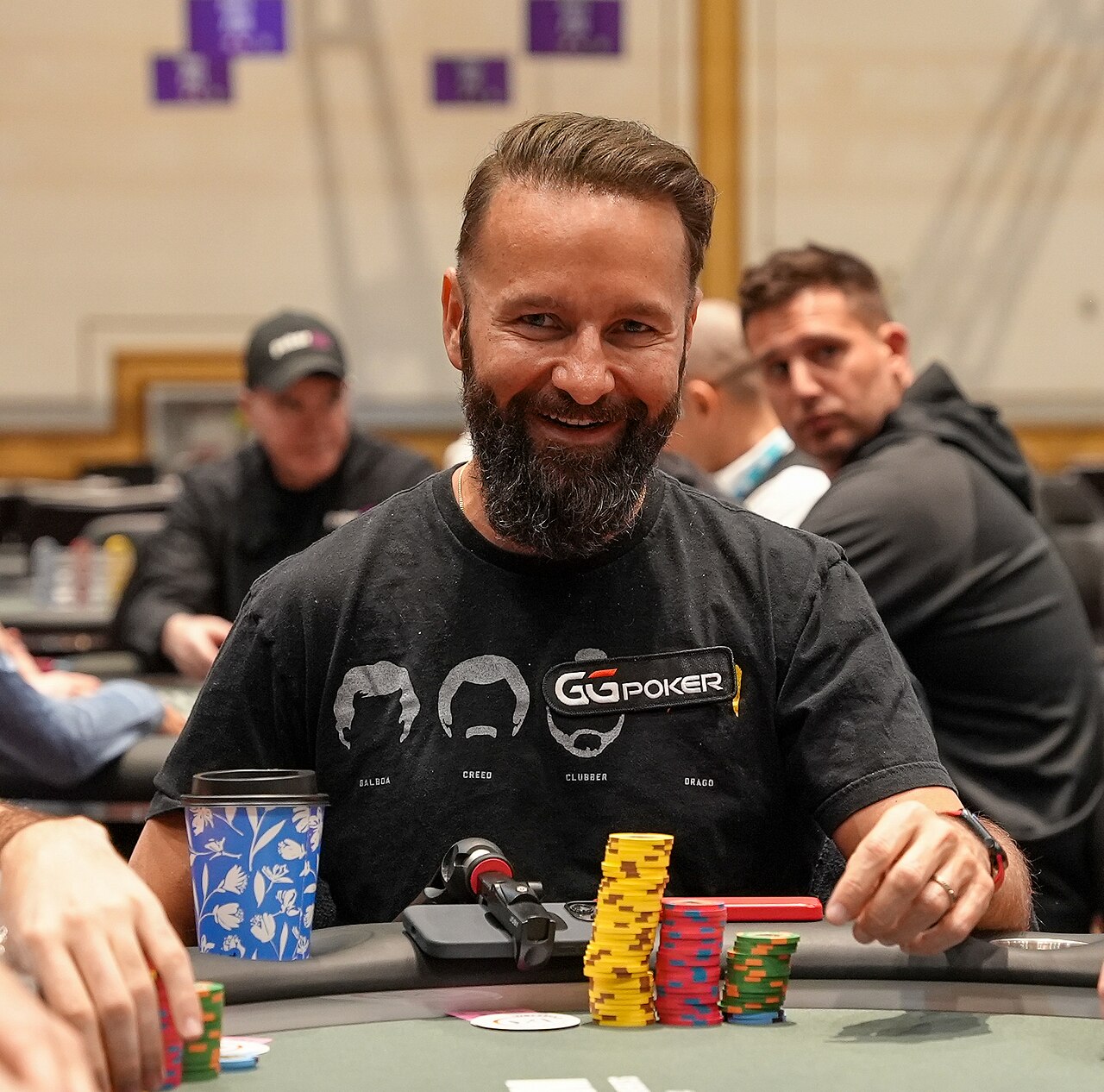
- Lead photo: Daniel Negreanu and David Rogier, Other People's Business podcast (MasterClass / YouTube). Daniel Negreanu portrait: Captain Q Farf / Wikimedia Commons, CC BY-SA 4.0.
- Article originally produced at poker.pro.
About the author

More Articles
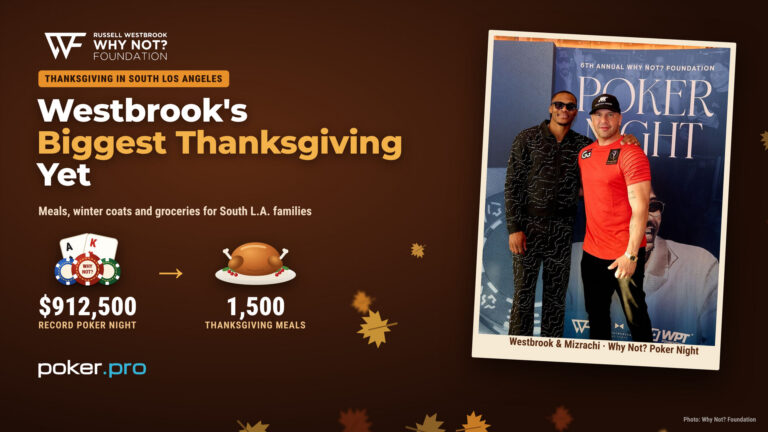
Russell Westbrook’s Why Not? Foundation Holds Biggest Thanksgiving Yet After Record Poker Night
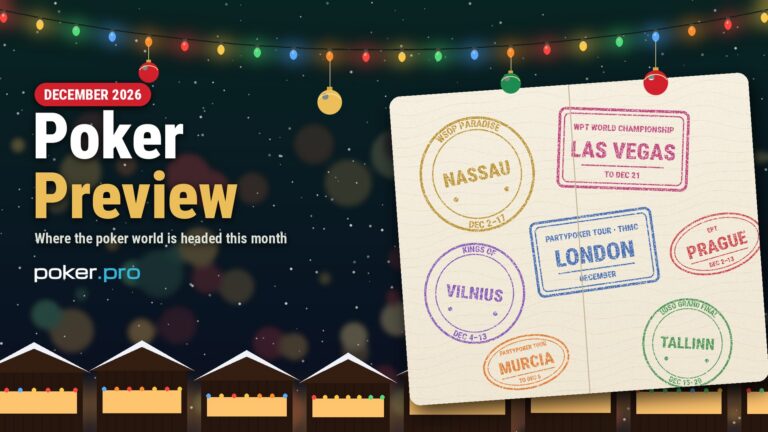
December 2026 Poker Preview From WSOP Paradise to PartyPoker Tour, THMC, and Kings of Vilnius
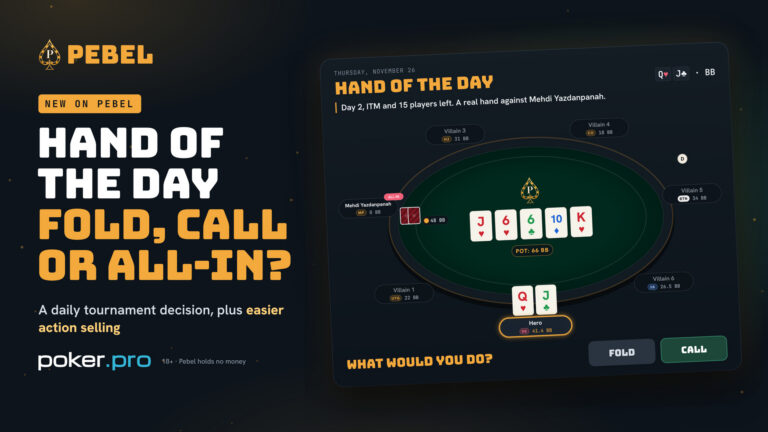
Pebel Steps Up Its Game with Hand of the Day and Easier Action Selling
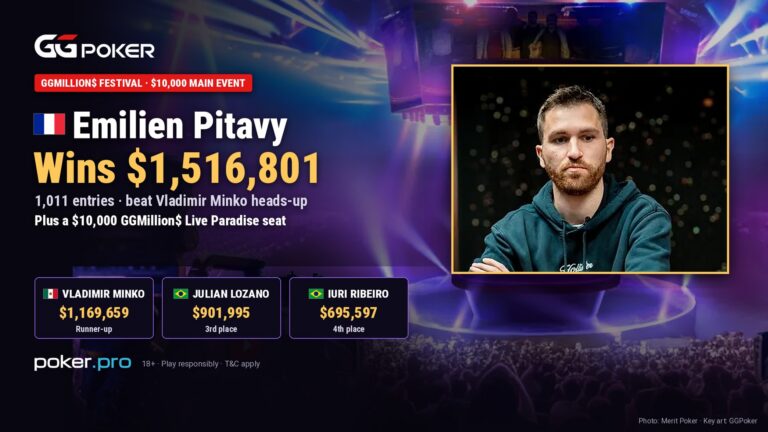
Emilien Pitavy Wins $1.5M at the GGMillion$ Festival Main Event
A Scratched Tesla, Silver Oak and Barack Obama – Daniel Negreanu Behind the Cameras
San Diego Casino Cheats Get Probation in Mississippi Stud Card-Marking Case

Baby Negreanu Is Here as Daniel Celebrates His Biggest Win Yet

HCL Clears Britney Jing, Suspends Her and C Ye Over Shared Action