








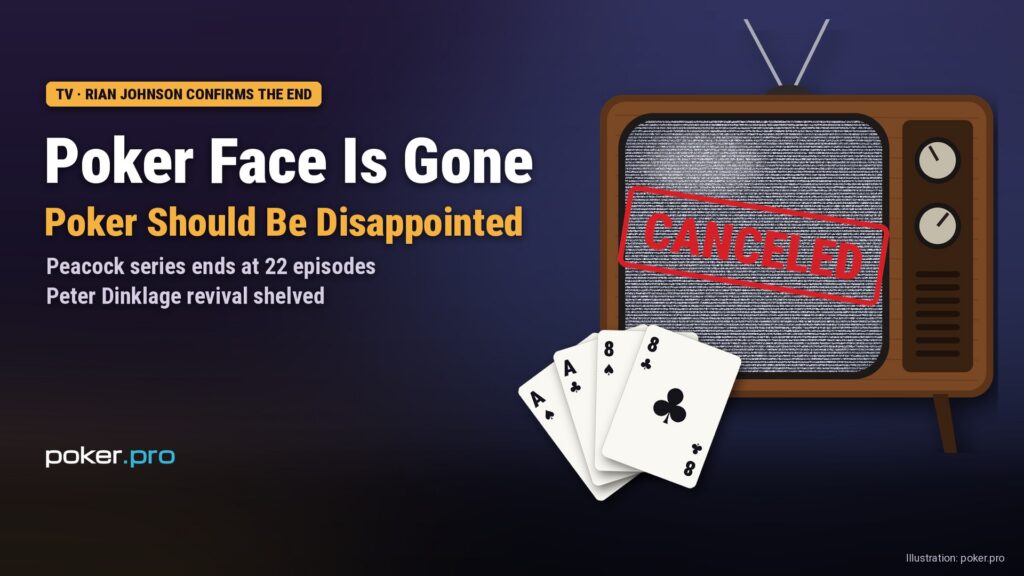
Rian Johnson has confirmed it: Poker Face is done. The Peacock series that gave the poker world its most high-profile television real estate in years has officially reached its resting place, the creator’s own words, and the plan to resurrect it with a new lead failed to secure a new home after being publicly shopped to other outlets.
- Read more: The History of Poker Media: From Jimmy the Greek to PokerGO
- Read more: A Scratched Tesla, Silver Oak and Barack Obama – Daniel Negreanu Behind the Cameras
- Read more: Baby Negreanu Is Here as Daniel Celebrates His Biggest Win Yet
- Read more: 2026 THMC London Will Be the Tour’s Final Stop of the Year










The show debuted on Peacock in January 2023 to some of the warmest critical reception any TV series has received in recent memory. Season 1 finished with a 98% score on Rotten Tomatoes. Season 2, which arrived in May 2025, scored 96%. Natasha Lyonne was Emmy-nominated for her performance. Guest stars ranged from Adrien Brody to Joseph Gordon-Levitt to Nick Nolte to John Mulaney. By almost every artistic measure, it was a hit. And then Peacock pulled the plug anyway.
What the Show Actually Was

The premise of Poker Face is deceptively simple. Charlie Cale, played by Lyonne, has a rare ability: she can tell with certainty when someone is lying to her. Not a hunch, not intuition, but a physical, involuntary reaction that fires every time deception enters the room. The show opens with her working as a cocktail waitress at a Nevada casino, her ability quietly working in the background, until a friend is murdered and she finds herself on the run from casino enforcers while solving a fresh murder in every new town she passes through.
Johnson modeled the format on classic Columbo, the "howcatchem" structure where the audience sees the crime and the killer from the start. The tension comes not from whodunit but from watching Charlie piece it together and corner whoever did it. In the hands of a lesser creator, it would have been repetitive. Johnson turned it into something addictive, with every episode its own self-contained film populated by an absurdly talented roster of one-off guest stars.
The Poker Connection: What's Real and What Isn't

The title is not an accident, but it is not what you might think. Poker Face does not follow the poker world. There are no tournaments, no bracelet events, no high-stakes cash games in the traditional sense. The connection runs through Charlie herself: her lie-detecting ability is what made her dangerous at a poker table. She could not read cards, but she could read every player in the room, and that's the story the pilot tells. Casino owner Sterling Frost Sr. caught her winning too consistently and spared her. His son, Sterling Frost Jr., played by Adrien Brody, later pressed her into service to help him cheat a business rival in an illegal poker game held in a hotel suite.
That is essentially the extent of the actual poker in the show. After the pilot, the series moves away from casinos and into the broader American landscape: auto shops, retirement homes, music studios, diners, bowling alleys. The poker connection becomes metaphorical. Charlie reads people the way a great poker player reads opponents, and the title holds. But anyone expecting a show about the game itself will be watching something different.
Even the pilot's poker scenes take some creative liberties. The illegal high-stakes game Frost stages serves as a backdrop rather than a focal point, and the show doesn't pretend to be a detailed portrait of how such games actually run. The title of the series premiere, "Dead Man's Hand," is classic poker vocabulary, referring to the two-pair hand of black aces and black eights famously associated with Wild Bill Hickok. The show drops the name without explaining it, which fits the vibe: the poker world is texture, not subject matter.
The human lie detector concept, meanwhile, is where the show most obviously departs from reality. Research finds that people are only modestly better than chance at detecting deception, and even trained professionals improve only marginally in controlled studies. The idea that someone could have a physical, infallible response to being lied to is pure fiction. The show knows this and leans into it rather than bothering to justify it. Charlie's ability is a superpower, the same way Columbo's rumpled brilliance is a superpower, and the show is better for not trying to dress it up in science.
Why It Was Canceled

The simple version: it was reportedly expensive to produce. Each episode was essentially a short film with its own location, its own world, and multiple celebrated guest stars who do not come cheap. The show's anthology-like format required a distinct setting and cast for nearly every episode, and that kind of overhead is sustainable when a streamer is fully committed. When the math stops working, it isn't.
Peacock canceled the show in November 2025, four months after the Season 2 finale aired. Lyonne told The Hollywood Reporter, "We weren't shocked!" citing episode budgets and ratings as factors. Johnson and his team had written the season's last episode, "The End of the Road," as a potential series finale, leaving the door open in both directions.
Johnson floated a plan to keep the show alive elsewhere. He and producer MRC shopped the show for a new home, targeting a two-season commitment, with Peter Dinklage reportedly lined up to replace Lyonne as the lead character. It generated considerable buzz. HBO chairman and CEO Casey Bloys confirmed that the network had conversations about the potential revival, though no commitment followed. It sounded like a show too good to die would find a way to survive.
It did not. In a Variety interview published in November 2026, Johnson said the revival is no longer moving forward and is currently "in its resting place." "The more we kind of explored it, the more it kind of didn't really make sense," he said. Johnson is writing an untitled thriller he describes as mostly a thriller with a dusting of sci-fi, something in the vein of the 1974 conspiracy film The Parallax View. Lyonne moves on. Dinklage never got to play Charlie. Poker Face ends at 22 episodes.
Why the Poker World Should Care

Television and poker have a complicated history. The early 2000s poker boom produced a wave of coverage, most of it centered on the World Series of Poker and the hole-card camera technology that suddenly made Texas hold'em watchable as a spectator sport. That wave eventually crested and receded, and the decades that followed saw poker shrink back toward its core audience.
Poker Face was something different. It was not poker media. It was mainstream prestige television that chose the poker world, the casino floor, the ability to read and deceive as its central framework. It put a woman whose superpower was the precise opposite of a poker face, a person constitutionally incapable of being lied to, at the center of a critically acclaimed drama that reached audiences well beyond anyone who has ever sat in a card room. That is the kind of cultural footprint the game rarely gets.
It is gone now, and what replaces it in that cultural space is unclear. Poker Face did not need to be a perfect poker show to matter. It just needed to exist, put the vocabulary and imagery in front of a wide audience, and be good enough that viewers remembered it. For two seasons, it did exactly that.
Poker Face: FAQ
What was Poker Face about?
Poker Face was a crime comedy-drama on Peacock created by Rian Johnson. Natasha Lyonne played Charlie Cale, a woman with an involuntary ability to detect lies, who works low-wage jobs across America while solving a new murder in every episode. The format was inspired by classic Columbo, with the audience knowing who committed the crime and watching Charlie figure it out.
Why was Poker Face canceled?
Peacock canceled the show in November 2025 after two seasons. Reporting cited high production costs and Season 2 ratings that were not as strong as Season 1's. Every episode required a new location and multiple well-known guest stars, creating substantial overhead. The show was critically acclaimed, with Season 1 at 98% and Season 2 at 96% on Rotten Tomatoes, but that was not enough to overcome the financial math.
What happened to the plan to revive Poker Face with Peter Dinklage?
After Peacock's cancellation, creator Rian Johnson and producer MRC shopped a proposed continuation to other networks and streamers, with Peter Dinklage reportedly lined up to replace Lyonne as the lead character. HBO chairman and CEO Casey Bloys confirmed the network had conversations about it, though no deal followed. In November 2026, Johnson said the proposed revival was no longer moving forward and was 'in its resting place,' adding that the more he and the team explored it, the more it 'didn't really make sense.'
How connected was Poker Face to actual poker?
The connection is thematic rather than literal. Charlie's lie-detecting ability made her formidable at the poker table, and the pilot features an illegal high-stakes poker game. After that, the show moves through the broader American landscape and poker becomes metaphorical. Charlie reads opponents the way a skilled player reads tells. The show does not cover tournaments, cash games, or the competitive poker world.
Is the human lie detector concept in Poker Face scientifically accurate?
No. Research consistently finds that people are only modestly better than chance at detecting deception, and even trained professionals improve only marginally over untrained observers in controlled studies. The idea of an infallible, physical response to being lied to is fiction. The show treats Charlie's ability as a superpower rather than a realistic skill, which is the right call. It was never trying to be a science documentary.
How many episodes did Poker Face run?
Twenty-two episodes across two seasons. Season 1 had ten episodes, running from January 26 to March 9, 2023. Season 2 had twelve episodes, running from May 8 to July 10, 2025. The show won multiple awards including an Emmy for guest actress Judith Light and a WGA Award for comedy writing. Natasha Lyonne received an Emmy nomination for lead actress.
- Sources: Variety, Variety (cancellation), The Hollywood Reporter, Rotten Tomatoes.
- Lead image: Natasha Lyonne as Charlie Cale in Poker Face. Photo: Peacock/Universal Television.
- Article originally produced at poker.pro.