










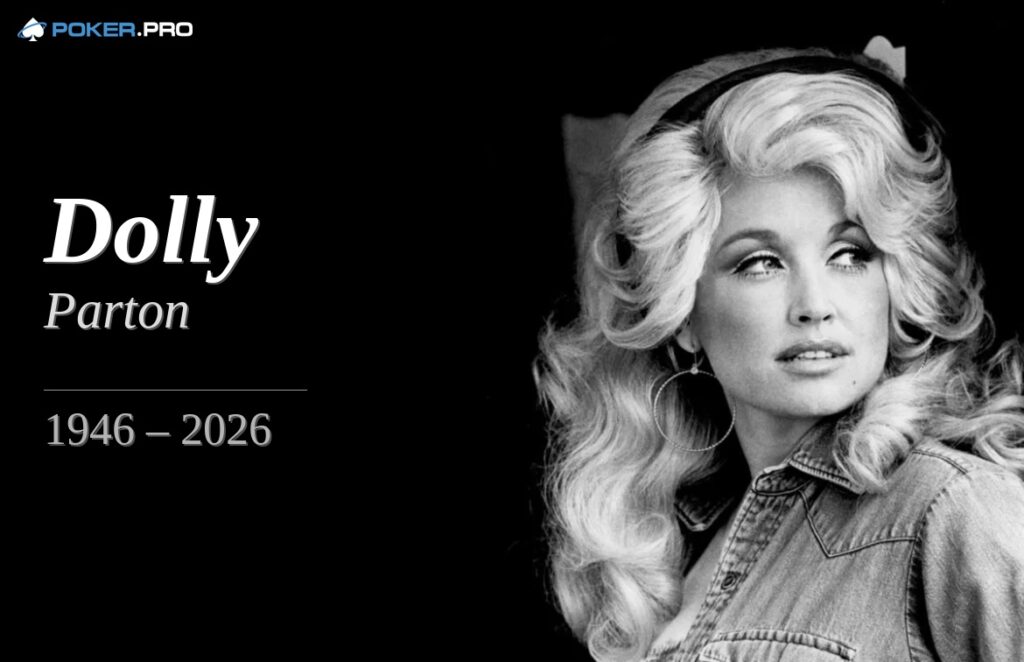
Dolly Parton died today, August 25, 2026, in Nashville, Tennessee. She was 80 years old. The family statement says she died peacefully. There is no good way to receive that news, and there is no version of today where it does not feel like a loss that reaches beyond music, beyond entertainment, into something more fundamental about the culture we all share.
poker.pro is a poker publication. We cover tournaments, players, festivals, and the business of the game. Dolly Parton was not a poker player. But she was part of the soundtrack of every card room I have ever sat in, and she was a presence in the broader culture that shaped the world poker players grew up in and live in. That is enough of a reason to stop and say something today.
Who She Was
Dolly Rebecca Parton was born on January 19, 1946, in a one-room cabin on the banks of the Little Pigeon River near Sevierville, Tennessee. She was the fourth of twelve children. Her father could not read or write. The family survived on very little. She left for Nashville the day after she graduated high school in 1964, carrying a suitcase and a guitar, and she never looked back. By the end of the 1960s she was a country music star. By the end of the 1970s she was an American icon. By the time she died she had sold more than 100 million records worldwide, written more than 3,000 songs, appeared in nine films, and launched a theme park that became one of the most visited in the United States. She was inducted into the Rock and Roll Hall of Fame in 2022, the Country Music Hall of Fame, and received a Lifetime Achievement Award from the Recording Academy. In 2025 she received the Jean Hersholt Humanitarian Award from the Academy of Motion Picture Arts and Sciences.
She was married to Carl Dean for 58 years, from 1966 until his death in March 2025. He was famously private, almost never photographed, essentially absent from the public life she had built, and she talked about him with warmth and affection for the entire duration of their marriage. When he died she wrote and released a song called “If You Hadn’t Been There” within days. She said he would always be the star of her life story. She had been dealing with health issues since his passing, and she acknowledged recently that she had not taken care of herself properly while caring for him through his illness. She died less than eighteen months after he did.
Kenny Rogers: A Partnership Built in a Studio Hallway
The story of how Dolly Parton and Kenny Rogers ended up making music together is one of the best accidental collaborations in the history of popular music. In 1982, Rogers was in a Nashville studio struggling to make a song called “Islands in the Stream” work. The Bee Gees had written it, originally for an R&B singer who passed on it, and Rogers could not find the right shape for it as a solo record. Dolly Parton happened to be recording in a nearby studio. Rogers and his producer Barry Gibb reached out. She walked down the hall. Within two or three hours, according to Parton’s own account, the record was done.
Rogers said afterward that the moment she walked into the studio, the song was never the same. “She lit it up,” he told interviewers, “and we became good friends from that point on.” “Islands in the Stream” was released in August 1983 as the first single from Rogers’s fifteenth studio album and peaked at number one on the Billboard Hot 100, giving both Parton and Rogers their second pop number-one. For Parton, the first had been “9 to 5” in 1981. For Rogers it was “Lady” in 1980. The two biggest country crossover stars of their era, brought together by a hallway and a half-finished song.
What followed was more than three decades of friendship, duets, tours, and a chemistry that the public never quite stopped speculating about. They were both married to other people throughout. They were clear about what the relationship was: a great friendship, a professional partnership, and a connection that both of them described as genuinely irreplaceable. Rogers said they had flirted with each other for thirty years and that the friendship was more electric than an affair would have been. Parton said she would always pinch him on the butt backstage. They did a Christmas album together in 1984 called “Once Upon a Christmas” and a CBS television special that drew 30 million viewers. They went on to record dozens of duets across more than three decades.
The poker connection between Dolly Parton and Kenny Rogers runs deeper than their friendship. Rogers had his own permanent place in the game long before he and Dolly ever recorded together. “The Gambler” was written by Don Schlitz in 1976 when he was 23 years old and had never gambled a day in his life. It took two years of shopping the song around Nashville before Rogers recorded it in 1978 and turned it into the most famous poker song ever written. It reached number one on the Billboard Hot Country Singles chart for three weeks in December 1978 and crossed over to the pop charts at a time when country songs almost never did. The chorus, “you gotta know when to hold ’em, know when to fold ’em, know when to walk away, know when to run,” has been quoted in more poker rooms, on more final tables, by more players and commentators and television broadcasters than any other lyric in the history of the game. Rogers always said the song was not really about poker. It was a metaphor for life. Poker players understood it both ways and loved it for both reasons.
So here is the full picture of what Dolly Parton and Kenny Rogers meant to poker together. Rogers gave the game its anthem in 1978. Parton gave it one of its most famous hand nicknames in 1980 with “9 to 5.” Together they recorded “Islands in the Stream” in 1983, one of the most played songs in the history of country music, a song that has been in the background of more poker rooms than either of them ever knew. Rogers died in 2020. Parton died today. Both of them have been in the game for decades and both of them will remain in it, in the lyrics of “The Gambler” every time a dealer says it and in the name of the 9-5 every time someone looks down at their hole cards and sighs.
Rogers died in March 2020, aged 81. Parton never stopped talking about missing him. “I miss him so much,” she told People in 2023. “I would always lighten up when that particular song was due in the setlist.” Ten days before she died, she posted a video on Instagram of the two of them singing “Islands in the Stream” together, captioned “43 years of Islands in the Stream.” It was her final Instagram post. She tagged a man who had been dead for six years. That says everything you need to know about what that friendship meant to her.
9-5: The Dolly Parton Hand
Here is the poker connection, and it is a real one. In no-limit hold’em, the 9-5 offsuit is known as the Dolly Parton hand. Named after her 1980 film and Academy Award-nominated song “9 to 5,” it is one of the most universally recognised hand nicknames in the game. Every poker player knows it. Every dealer has announced it. It is part of the shared language of the game in a way that very few cultural references manage to be, and it has been for decades.
The 9-5 is not a good hand. It is a trash hand in most situations, a hand you fold preflop without much deliberation in a serious game. But it has a name, and that name belongs to Dolly Parton, and that means she has been present in poker rooms in a specific and concrete way for as long as the nickname has existed. Dealers call it out. Players groan or laugh when they see it in the hole. Sometimes someone runs it down and wins a pot they had no right winning with nine-five offsuit, and the table reacts the way tables always react when someone gets lucky with a hand they should have mucked. It is a small moment, repeated in card rooms around the world every single day, and Dolly Parton’s name is attached to every one of them.
That is a strange kind of immortality, but it is a real one. Most people who are famous are famous for what they made. Dolly Parton is famous for what she made and also for a poker hand she almost certainly never played. She gave the game one of its best named hands and she did it by writing a song about working-class women who deserved better, which is as good an origin story for a poker nickname as you are going to find. The song won the Academy Award for Best Original Song. The hand is garbage. Both of these things are true and neither of them diminishes the other.
In the years since the nickname took hold, “9 to 5” has been played in poker rooms in Las Vegas, in Tallinn, in Malta, in Miami, in Macau, in every cardroom on every continent where someone has been dealt a nine and a five. The song has been on the speakers in many of those same rooms. Dolly Parton has been in the game, whether she knew it or not, for a very long time.


What She Meant Across Generations
The remarkable thing about Dolly Parton, the thing that made her genuinely unusual among artists of her era, was that her audience never aged out of her. Most artists from the 1970s are beloved by the people who grew up with them and largely invisible to everyone else. Dolly was different. People who were born decades after “Jolene” was recorded discovered it and felt it as urgently as anyone who heard it first in 1973. The song about a woman pleading with another woman not to take her man had no right to feel that universal, and yet it did, and it still does, and it will long after today.
Part of that was the writing. She was a genuinely great songwriter, not great for country or great for the era. Great, full stop. “I Will Always Love You” was written as a farewell to a business partner, not a romantic love song, and it became one of the most recorded songs in history. She wrote it in 1973 and sold the rights to Whitney Houston’s cover in 1992 for a sum that changed her financial position permanently. The story of those two versions of the same song, written by the same woman, covering thirty years of American music, could fill a book on its own.
Beyond the music, Dolly Parton was a specific kind of public figure that almost does not exist anymore. She was beloved across political lines at a time when almost nothing is. She was funny without being cruel. She was honest about where she came from without performing poverty. She was generous in ways that were documented and real, most notably the Dollywood Foundation’s Imagination Library, which has mailed free books to children from birth to school age since 1995 and has distributed more than 200 million books across multiple countries. She funded it herself and kept funding it for three decades because she believed in it and because she remembered growing up in a house where books were scarce.
In the Card Room
Beyond the 9-5, Dolly Parton has always been part of the soundtrack of poker. Card rooms in the American South have a country lean and she has always been part of that background. “Jolene” on the speakers during a late-night cash game session is a specific kind of atmosphere that anyone who has played in those rooms knows without being able to explain. The song has a tension in it that suits a poker room. The stakes are clear, the outcome is uncertain, and the person singing it is trying everything they have.
There is also a quality in Dolly Parton’s public persona that has always resonated with poker players specifically. She was self-aware without being self-pitying. She understood that image and reality are different things and she played with that distinction deliberately and intelligently for her entire career. She was famously quoted as saying it costs a lot of money to look this cheap. That is a line a poker player understands immediately. The gap between what you show and what you have is the entire game.
Rest in Peace, Dolly!
The family statement says her legacy is one of love, compassion, and resilience. That is the right word for it. She grew up with nothing, lost the man she spent sixty years with, kept working through her grief and her health issues right up until the end, and left behind a body of work that will outlast most of what is being produced today by people a quarter of her age.
Dolly Parton was 80 years old. She lived well, worked hard, loved genuinely, and gave back in ways that will continue long after today. The next time someone gets dealt a nine and a five in a card room somewhere and the dealer calls out the Dolly Parton hand, that is her too. Still in the room. Still part of the game.
Our condolences to the Parton family and to everyone for whom her music has meant something.
- Article originally produced at poker.pro.
About the author

More Articles

Pebel Is Changing How Poker Staking Works

GGPoker Launches Ocean KO: The Jackpot PKO Format That Changes Every Knockout

Norway’s Online Poker Exile: World Champions, Blocked Platforms and What Changes if Norsk Tipping Gets Poker

Join poker.pro on Telegram for Breaking Tournament News and Results

Lucas Archeny Wins 2026 Winamax Poker Open Aix-les-Bains Main Event for €150,000

Join the Card Casino Šamorín High Stakes Cash Game October 8-11
Brazil Banned Betting… Nobody Asked About Poker
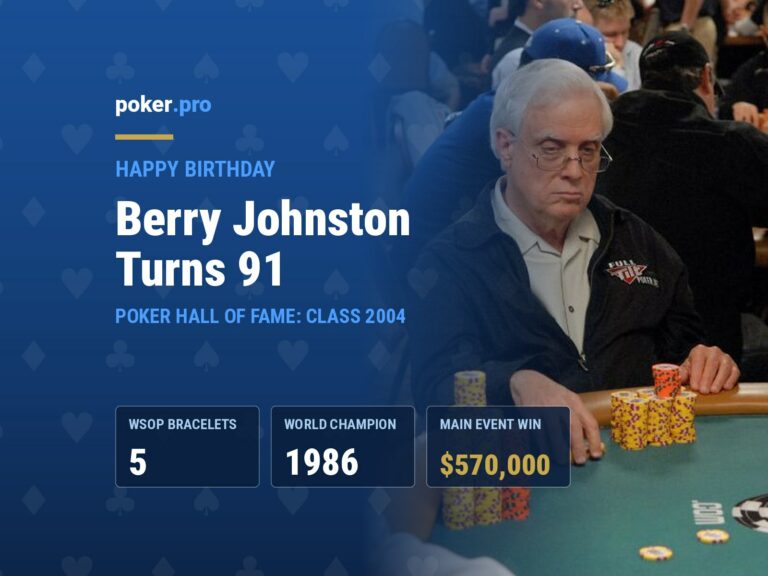
Happy Birthday, Berry Johnston: WSOP Champion and Hall of Famer Turns 91