






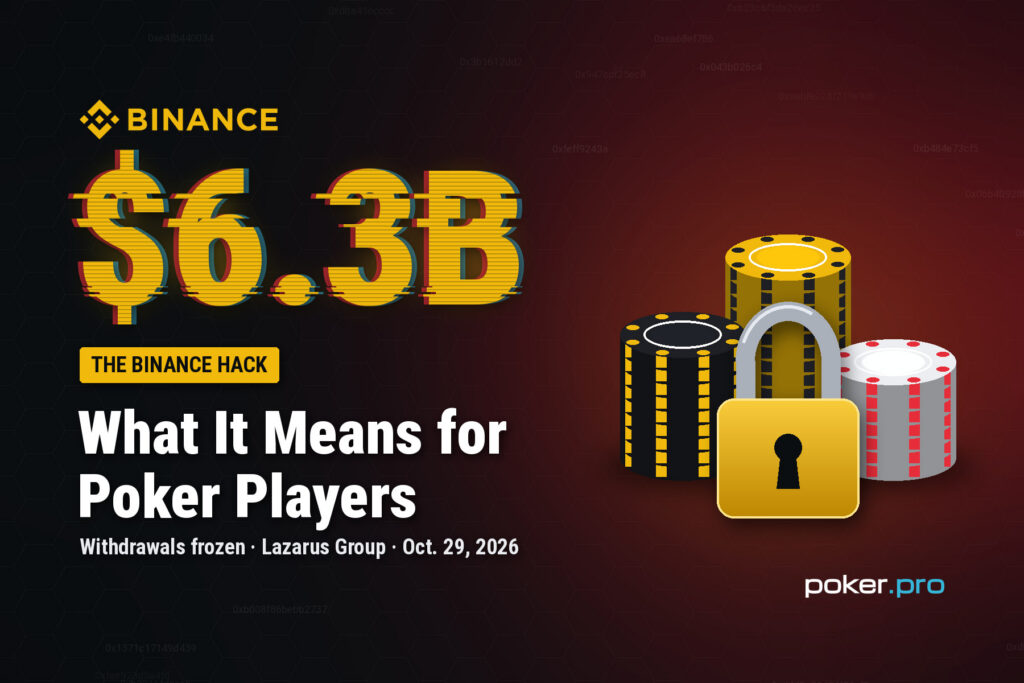
The largest cryptocurrency theft in recorded history hit Binance on October 29, 2026, with hackers attributed to North Korea’s Lazarus Group draining an estimated $6.3 billion from the exchange’s hot wallets in a coordinated attack that lasted less than four hours. The exchange froze withdrawals, stablecoin issuers froze roughly $3 billion of the stolen funds, and Bitcoin fell nearly 5% to below $77,000 before recovering. For poker players, whose relationship with crypto and Binance runs deeper than any other segment of the gambling world, the implications cut across online deposits, live tournament cash games, satellite pathways, and the broader trust infrastructure that has made crypto poker viable.
- Read more: Join Poker Pro on Telegram for Breaking Tournament News and Results
- Read more: Luxon Pay Review 2026



What Happened: The Biggest Crypto Heist on Record
The attack began at around 20:05 UTC on October 29. Within roughly 20 minutes, the attacker moved funds across ten separate blockchains simultaneously, targeting Binance's hot wallets: the internet-connected accounts the exchange uses to process day-to-day withdrawals. Ethereum bore the brunt of it, with about $3.79 billion drained. Bitcoin hot wallets lost 18,270 BTC (roughly $1.47 billion at the time). The rest came out of Tron, XRP, Solana, Avalanche, and Polygon in waves that continued into the early hours of October 30.
Blockchain intelligence firm TRM Labs, which investigated the attack and attributed it with high confidence to North Korea's TraderTraitor unit (a subgroup of the Lazarus Group), described a method that was technically sophisticated and operationally well rehearsed. On Ethereum, the attacker used an EIP-7702 delegation to convert a Binance hot wallet into a contract it controlled, executing 50 pre-signed authorizations in one burst. On other chains, it used ordinary signed transfers executed through the same narrow time window. TRM assesses that Binance's hot wallet signing infrastructure was compromised, not that private keys were directly leaked.
Binance confirmed the entry point appears to have been a compromised laptop belonging to a DevOps engineer, giving the attacker access to a service container and, from there, to the signing infrastructure. This aligns with how the Lazarus Group operated in the $1.5 billion Bybit theft in early 2025, previously the largest crypto heist on record. The Binance attack is approximately four times larger.
Stablecoin issuers moved fast: Tether froze about $1.57 billion in USDT, and Circle froze over $800 million in USDC, bringing total frozen assets to approximately $3 billion. The attacker anticipated this and converted much of the USDT to other assets at steep discounts before issuers could act. As of October 30, the attacker still reportedly held more than 420,000 ETH and 18,270 BTC, roughly $2.4 billion in assets that no issuer can freeze.
Binance suspended all deposits and withdrawals and announced that user funds are safe. Co-CEO Yi He said the exchange would cover all losses using its Secure Asset Fund for Users (SAFU), which holds approximately $1 billion in bitcoin, supplemented by company reserves. Founder Changpeng Zhao, who is Binance's largest shareholder but no longer its CEO, said he expects all user funds to be fully covered.
What This Means for Online Poker Players
Binance is not a poker site. But it is the exchange that tens of thousands of poker players use as the on-ramp and off-ramp for crypto poker, and the disruption it has caused flows directly into the online poker ecosystem. Withdrawals are frozen across all networks while Binance investigates. Players who hold funds on Binance, or who were moving crypto onto a poker site or cashing out from one, are stuck with locked accounts, with no timeline for when access will resume.
The online poker rooms most exposed to this are the crypto-native platforms, which process entirely in crypto and depend on Binance as the primary bridge between players and their bankrolls. A player who cashes out to a Binance wallet and finds withdrawals frozen is not a player who can get to their money today. The rooms themselves are not affected by the hack, but the plumbing that connects them to real-world liquidity is.
GGPoker, the world's largest online poker room and the primary crypto-accepting platform for recreational players, accepts cryptocurrency deposits but is not crypto-native. Players whose funds are already on GGPoker are unaffected. Players who use Binance to convert fiat to crypto before depositing, however, cannot do so while withdrawals are locked. GGPoker also serves as the exclusive international satellite host for the WSOP, including WSOP Paradise 2026 in December. Players who were mid-process in earning or converting satellite seats involving crypto face a practical roadblock until Binance restores normal operations.
Bitcoin's 5% drop to below $77,000 also hits players whose poker bankrolls are denominated in BTC. A player who cashed out $10,000 worth of BTC from a poker site last week and left it in Binance now has a balance worth roughly $500 less, on top of being unable to move it. Players who hold significant bankrolls in ETH are in a similar position after ether's near-6% drop. These are not catastrophic losses for most players, but they are a reminder of the volatility cost of holding poker bankrolls in crypto.
The Live Game Angle: High-Stakes Cash and Tournament Buy-Ins
Crypto's role in live poker extends well beyond online deposits. High-stakes cash game players have used crypto as a primary settlement mechanism for years, and Binance has been the backbone of that infrastructure for international players who need to move large sums without wire transfer delays or banking scrutiny. When a player in Macau, London, or the Bahamas wants to move $200,000 in winnings, converting to BTC and using Binance to settle is often the most practical option available.
With Binance locked down, those settlement channels are disrupted. The high-roller community that gathers around WSOP Paradise beginning December 1 will be arriving at Baha Mar during a period when the exchange they rely on is either still recovering or has just returned to normal operations after what may be a lengthy technical review and security rebuild. The timing matters: WSOP Paradise is the closing leg of the global WSOP Player of the Year race, and it draws the highest concentration of crypto-comfortable players of any event on the calendar.
Live tournament buy-ins at crypto-integrated events also become more complicated. Some smaller tournament series accept direct crypto payments for buy-ins. If a player's crypto holdings are tied up in Binance during a freeze that extends into early November, they lose flexibility in how they fund live entries, particularly at events that run outside the banking system's normal hours and timelines.
The Broader Trust Question
Poker players were among the earliest adopters of cryptocurrency as a banking tool, driven partly by necessity: the Unlawful Internet Gambling Enforcement Act of 2006 cut off traditional payment processors for most US players, and crypto offered an alternative that bypassed the banking system entirely. That early adoption created a culture of crypto comfort in the poker world that still defines how the upper tier of the player pool moves money today. The Binance hack challenges the assumption that underpins it all: that a centralized exchange, however large, can be trusted as a safe holding environment for poker bankrolls.
For the individuals directly caught in the attack, the consequences can be devastating. Players who held significant bankrolls in Binance during the breach window may have had funds swept before the exchange suspended withdrawals. Even where the SAFU pledge ultimately makes them whole, an indefinite freeze means no access to money that could represent months of winnings, a buy-in for an upcoming major, or a player's entire working bankroll. Waiting on a multinational exchange to complete an investigation and process compensation is not the same as having your money. The uncertainty alone is serious harm, and for anyone already running thin, it can be catastrophic.
Binance has $1 billion in its SAFU fund and says it will cover losses. On paper, retail users with funds on the exchange are protected. But "protected" does a lot of work in a situation where a foreign state actor moved $6.3 billion in under four hours. The attack also did not require a private key leak. It required access to a signing infrastructure, which means no amount of a player's individual security hygiene would have prevented their funds from being swept if they were in an affected hot wallet.
The argument for hardware wallets and self-custody, which the poker community has debated for years without reaching consensus, becomes louder after an attack like this. Funds held in a Ledger or Trezor cold wallet cannot be touched by a compromised exchange employee's laptop. Funds held in a Binance hot wallet can be. The players most likely to act on that lesson are those with the largest balances, which means some of the biggest names in crypto poker may accelerate a shift to self-custody that was already underway at the margins.
Whether that shift happens in practice depends on Binance's post-incident behavior. If withdrawals resume within days, the SAFU fund covers losses cleanly, and the exchange publishes a credible technical post-mortem, most players will stay. If the freeze extends into weeks, or if the compensation process is slow or disputed, the poker community will remember it the way they remember the Full Tilt Black Friday seizure: as the moment a trusted institution failed and some portion of the player pool never came back.
What Players Should Do Right Now
For players with funds currently on Binance, the practical advice is straightforward. Do not panic and do not attempt workarounds that involve unverified "alternative withdrawal" links, which Binance has specifically warned are scams proliferating in the aftermath of the incident. Your funds are frozen but should be intact: the attacker targeted Binance's own hot wallets, not individual customer account balances, and the SAFU commitment covers any shortfall.
Players who need to make deposits or withdrawals in the near term should route through alternative on-ramps. Luxon Pay processes poker deposits and withdrawals independently of Binance. Kraken, Coinbase, and OKX remain operational. Players with funds already on GGPoker or other regulated rooms are unaffected by the freeze and can play normally. The disruption is at the Binance layer, not at the poker room layer.
The longer-term question of where to hold poker bankrolls between sessions is one every crypto-comfortable player will think about differently after October 29, 2026.
Binance Hack 2026: FAQ
How much was stolen in the Binance hack?
Binance estimates the total impact at approximately $6.3 billion, making it the largest crypto heist in recorded history. The previous record was the $1.5 billion Bybit hack in early 2025, attributed to the same North Korean threat group. Of the stolen funds, stablecoin issuers Tether and Circle froze roughly $3 billion, but the attacker still reportedly holds more than $2.4 billion in unfrozen ETH and BTC as of October 30, 2026.
Who was behind the Binance hack?
Blockchain intelligence firm TRM Labs attributed the attack with high confidence to TraderTraitor, the North Korean hacking unit linked to the Lazarus Group. Independent researcher ZachXBT and security firm Blockaid both reached the same conclusion independently, citing tactics consistent with prior North Korean operations including the Bybit hack. The initial access point appears to have been a compromised laptop belonging to a Binance DevOps engineer.
Are Binance user funds safe after the hack?
Binance says yes. The exchange has committed to covering all losses from the hack using its Secure Asset Fund for Users (SAFU), which holds approximately $1 billion in bitcoin, supplemented by company reserves. Co-CEO Yi He and founder Changpeng Zhao have both publicly stated that user funds will be fully covered. Whether that commitment holds depends on the final scope of the losses after stablecoin freezes are netted out and the investigation concludes.
How does the Binance hack affect online poker players?
Players with funds on Binance cannot deposit or withdraw while the exchange's network operations are suspended. This is most disruptive for players who use Binance as their primary crypto on-ramp for online poker sites, including crypto-native rooms like BCPoker and BC.Game. Players whose bankrolls are already on a poker site such as GGPoker are unaffected. The 5% drop in Bitcoin and near-6% drop in Ether also reduces the dollar value of poker bankrolls held in those assets.
Should poker players move their bankrolls off Binance?
Players cannot currently move funds off Binance while withdrawals are suspended. Once withdrawals resume, players with large holdings should consider whether a centralized exchange hot wallet is the right long-term storage for a poker bankroll. Cold wallets (hardware wallets like Ledger or Trezor) provide self-custody protection that exchange hot wallets do not. Players with smaller operational balances may find the convenience of Binance still outweighs the risk once normal operations resume.
Will the Binance hack affect the WSOP Paradise 2026 in December?
Indirectly, yes. WSOP Paradise begins December 1 at Baha Mar and draws a high concentration of crypto-active players who use Binance as their primary settlement tool for large live cash game transfers and buy-ins. If Binance operations are not fully restored well before then, some high-stakes players may face logistical friction in moving funds to Nassau. GGPoker, which runs international WSOP qualifiers, is not itself affected, but players using Binance to fund their GGPoker accounts for satellite play will be until withdrawals resume.
- Article originally produced at poker.pro.
About the author

More Articles
The Top 5 Benefits of Using Cryptocurrency in Online Poker
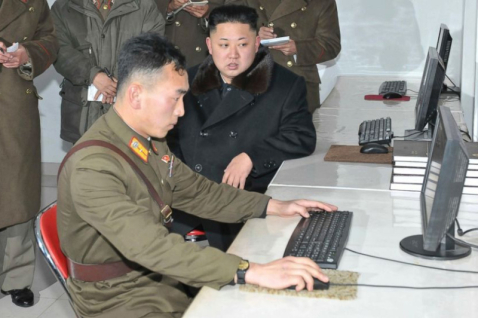
North Koreans Hacked Cryptocurrency Gambling Site Stake.com, Stealing $41 Million
PartyPoker MILLIONS Brings $2m GTD Main Event and Poker Ape NFT Giveaway
GGPoker Introducing NFT Avatars
Greek-American Poker Player Filippos Liakounakos Arrested for $500K Bitcoin Scam
Where Can You Use Bitcoin Today?
Send Cash to an Ethereum Address With Skrill
Enter Cryptoworld Risk-Free with Skrill