






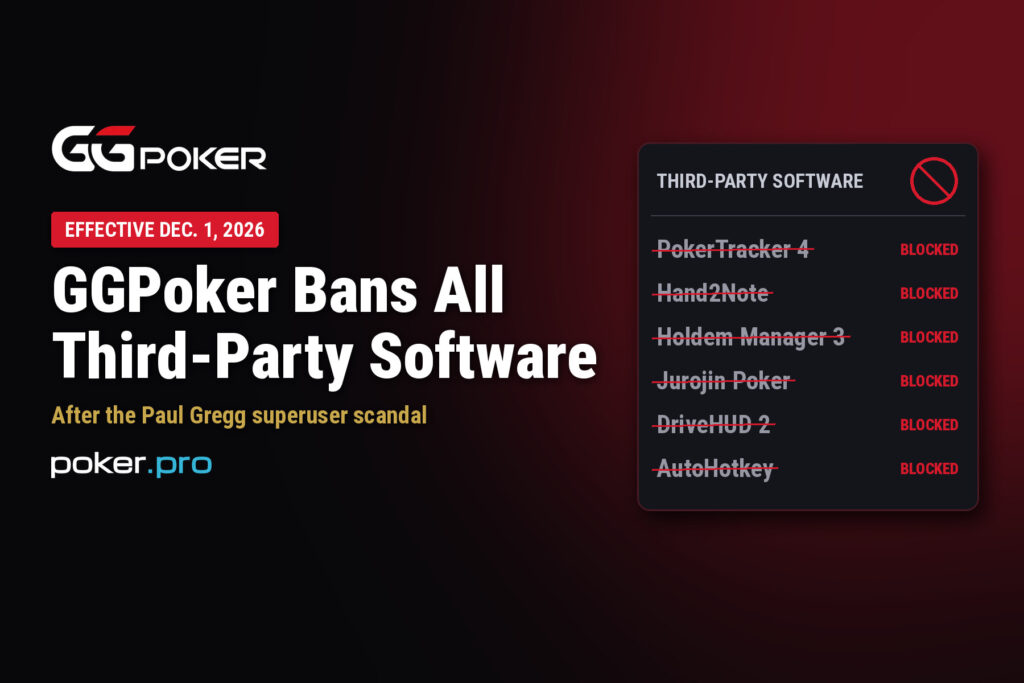
GGPoker has announced a ban on all third-party poker software, effective December 1, 2026, following a superuser scandal that exposed critical security vulnerabilities in how external tools interact with the platform. The policy, announced October 15, covers a wide range of software including hand trackers, HUDs, table managers, and automation tools, and applies to all GGPoker clients worldwide. Players have until November 30 to adjust before enforcement begins.
The ban is a direct response to what GGPoker described as a recent security incident. In early October, cybersecurity researcher @wolfsec0x0 publicly exposed an account known as “Paul Gregg” that had allegedly used compromised third-party software, including Jurojin Poker, to remotely view opponents’ hole cards in real time.
Suspicious activity linked to the account was first reported about two years earlier, and the alleged scheme is believed to have targeted an estimated 10 to 30 high-stakes players across multiple sites, including GGPoker, CoinPoker, and WPN. Spain’s Ignacio Moron said he lost about $60,000 to the Paul Gregg account in less than an hour and estimated his total losses at $150,000 to $200,000. Poker coach Patrick Howard, who reported the account to GGPoker in September 2026, later said of the ban: “This will change online poker forever.”
GGPoker stated: “Previously, we permitted certain third-party tools that did not affect gameplay. Following the recent incident, we are tightening this policy to better protect our players and reduce the risk of a similar incident.”
- Read more: Bryn Kenney Sues GGPoker: $90M Earner Claims Fraud and Broken Equity Deal
- Read more: GGPoker Launches Ocean KO: The Jackpot PKO Format That Changes Every Knockout
- Read more: Join poker.pro on Telegram for Breaking Tournament News and Results






What is banned
GGPoker's updated policy prohibits all third-party poker software. The company named the following tools explicitly, while noting the list is not exhaustive: Jurojin Poker, PokerTracker 4, Hand2Note, Holdem Manager 3, StarsCaption, DriveHUD 2, Intuitive Tables, Lobbyze, Equilab, and AutoHotkey. OS-level window managers such as PowerToys on Windows and Rectangle on Mac are not classified as third-party tools and remain permitted.
Players running a flagged tool will receive an in-client warning when detected. Failing to close it may result in a temporary suspension or a permanent ban.
New security measures
Alongside the ban, GGPoker is rolling out a suite of new security features. Screen Guard blocks screenshots, screen recordings, and remote viewing of open tables, with an extended mode that covers the lobby, cashier, and account pages as well. A Connection Monitor flags apps with suspicious network connections, including remote desktop tools and proxies. A DNS Check detects hijacking attempts. Players can whitelist trusted applications through an Allowed Processes list.
GGPoker is also deploying Win-Rate Anomaly Detection, which reviews player decisions against opponents' actual hole cards and flags statistically impossible accuracy that may indicate real-time assistance. The platform says it traced funds linked to the Paul Gregg account to a crypto wallet and has reported findings to Coinbase and law enforcement.
To offset the loss of popular table management features, GGPoker is building native replacements into the client: table swapping, layout locking, and focus management tools will roll out in phases from October 23, with full availability by December 1.
What it means for players: pros and cons
The ban has practical implications for many player types, and the community's reaction has been mixed.
Arguments in favor
The Paul Gregg scandal showed that third-party software can become a vector for cheating at a level ordinary players can't detect or defend against. By eliminating the attack surface entirely, GGPoker removes the mechanism that allowed hole-card exposure.
Recreational players, who rarely use tracking software, stand to benefit most: they were the likeliest victims of an opponent with a technological edge, and the playing field levels considerably when no one at the table has access to hand histories, HUD stats, or real-time assistance tools. The security upgrades that accompany the ban, particularly Win-Rate Anomaly Detection, give GGPoker tools to identify future cheating attempts more proactively.
Arguments against
For serious grinders and professionals, the ban removes tools they have used legally for years to manage tables, study their own game, and build databases. PokerTracker, Holdem Manager, and Hand2Note are not cheating tools in ordinary use. They track hands a player has already played and display aggregated statistics.
Banning them alongside the software that enabled the Paul Gregg attack treats legitimate tools as equivalent to malicious ones. Multi-tablers who rely on table managers like DriveHUD and Jurojin to organize their sessions will need to wait for GGPoker's native replacements to reach feature parity. Jurojin, which was compromised by attackers rather than cheating, pushed back and called for clearer technical standards and cooperation between operators and software providers, rather than a blanket ban.
There is also a liquidity argument. High-volume regulars are a significant source of rake, and alienating the most active grinders risks thinning out higher-stakes games. Some players may simply shift their volume to PokerStars or other sites that maintain an approved-tools list rather than an outright ban.
Others may find a workaround: run GGPoker on one machine while using PokerTracker or Hand2Note on a second computer, where detection software can't reach. A policy that drives serious players to competitors, or to two-machine setups, restricts third-party tools on GGPoker while leaving the underlying behavior largely intact.
Patrick Leonard, a CoinPoker ambassador, acknowledged the scale of the problem without endorsing every aspect of the solution: "The future of online poker is in the hands of the sites." He noted that around 100 players had previously raised suspicions with various sites about unusual opponents, suggesting the industry had not adequately addressed the issue before it reached the level of public scandal.
Why GGPoker acted
Three factors converged. The account known as Paul Gregg remained active for approximately two years despite multiple player complaints, which created reputational and legal exposure for the platform. The mechanism of the attack, which used compromised third-party software to expose hole cards remotely, was specific enough that banning all such software was the most direct way to close the vulnerability quickly. And GGPoker was already building native table management features, which gave the company a timeline for offering players an alternative before enforcement began.
No other major operator has announced an equivalent blanket ban, though ACR Poker has introduced Screen Shield in response to the scandal. PokerStars maintains an approved-tools list that permits PokerTracker 4, Holdem Manager 3, and similar software while blocking real-time assistance and shared databases; most other major sites have taken a similarly selective approach rather than banning third-party tools outright. The Paul Gregg case has made clear that the line between a legitimate tool and a cheating mechanism is not always visible to the user running the software.
GGPoker Third-Party Tool Ban: FAQ
What third-party tools has GGPoker banned?
GGPoker has banned all third-party poker software effective December 1, 2026. Tools named explicitly include Jurojin Poker, PokerTracker 4, Hand2Note, Holdem Manager 3, StarsCaption, DriveHUD 2, Intuitive Tables, Lobbyze, Equilab, and AutoHotkey. The list is not exhaustive. OS-level window managers such as PowerToys on Windows and Rectangle on Mac are not affected by the ban.
Why did GGPoker ban third-party tools?
GGPoker banned third-party tools following a superuser scandal in which an account called Paul Gregg used compromised third-party software to view opponents' hole cards in real time. The alleged scheme ran for approximately two years and is believed to have targeted an estimated 10 to 30 high-stakes players across multiple sites. GGPoker said the ban is intended to protect players and reduce the risk of a similar incident.
When does GGPoker's third-party tool ban take effect?
GGPoker's ban on third-party tools takes effect December 1, 2026. Players have a transition window until November 30, 2026, during which no automated warnings or penalties apply. From December 1, players detected running a flagged tool will receive an in-client warning, and failure to close it may result in a temporary suspension or permanent ban.
What is the Paul Gregg superuser scandal?
The Paul Gregg account was exposed by cybersecurity researcher @wolfsec0x0 in early October 2026. The account allegedly used compromised third-party software, including Jurojin Poker, to view opponents' hole cards in real time. Suspicious activity was first reported about two years earlier, and the scheme is believed to have targeted an estimated 10 to 30 high-stakes players across multiple sites including GGPoker, CoinPoker, and WPN. Spain's Ignacio Moron estimated his total losses to the account at $150,000 to $200,000.
What security features is GGPoker adding alongside the ban?
GGPoker is rolling out several new security features including Screen Guard, which blocks screenshots and remote viewing of open tables; a Connection Monitor that flags suspicious network connections; Win-Rate Anomaly Detection that identifies statistically impossible decision accuracy; a DNS Check for hijacking attempts; and an Allowed Processes list for whitelisting trusted applications. GGPoker says it has also reported findings from the Paul Gregg investigation to Coinbase and law enforcement.
Will GGPoker replace the banned table management tools?
Yes. GGPoker is building native table management features into the client to replace third-party tools, including table swapping, layout locking, and focus management. The rollout begins October 23, 2026, with full availability by December 1, 2026, when the third-party tool ban takes effect.
- Article originally produced at poker.pro.
About the author

More Articles

Bryn Kenney Sues GGPoker: $90M Earner Claims Fraud and Broken Equity Deal

GGPoker Launches Ocean KO: The Jackpot PKO Format That Changes Every Knockout
The Supreme Court Hearing That Could Reshape Online Poker in Canada on Oct. 7

UK Remote Gaming Duty Doubles April 1: No Immediate Changes for Online Poker Players

The 2026 UKPC Kicks Off Dusk Till Dawn’s Live Poker Season

Dara O’Kearney and David Lappin Cut Ties With WPT Global After Tony “Ren” Lin Signing

The 2026 WSOP Europe Chooses Hilton Prague as Its Venue
Twitch Poker Streaming Highlights – August 2025