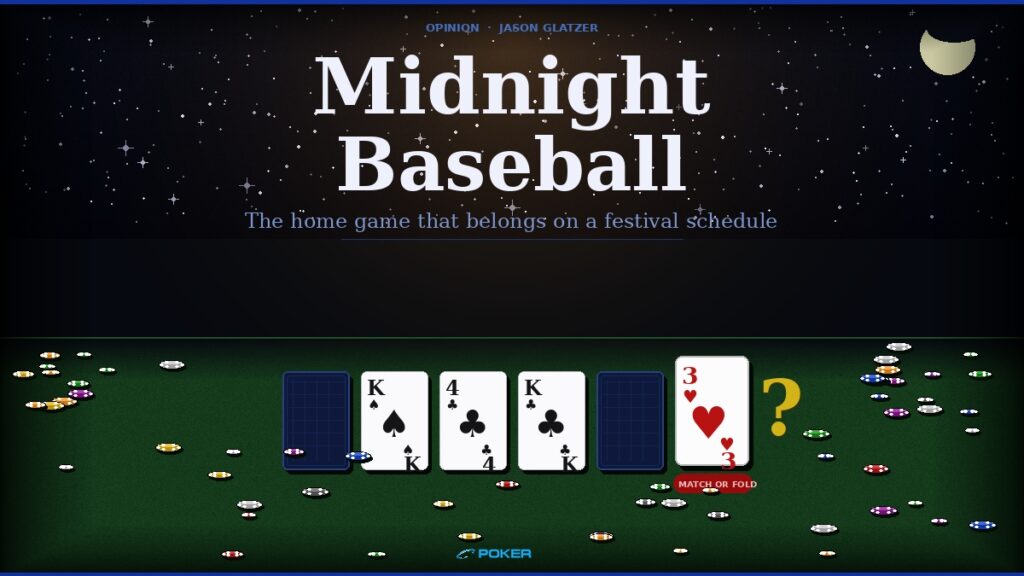
There is a sound I still associate with being twelve years old: five or six people groaning in unison, in a basement, on a dining room table, or on the floor in the commons in between classes, because somebody turned over a three.
The game was Midnight Baseball. You got seven cards, face down, and you were not allowed to look at them. Not a peek, not a squeeze, nothing. You turned them over one at a time in front of everybody, and you found out what you had at the same moment your opponents did. Threes and nines were wild. If you turned a four, you could buy an extra card. And if you turned a three, you had to match the entire pot or throw your hand away.
I was young when I picked it up. Young enough that I doubt whoever taught me had it exactly right, and certainly young enough that I did not. I was already playing cards constantly with the same handful of kids, whatever we had learned from older siblings, parents, grandparents, and other family and friends dealt badly at a kitchen table, and within about a week of learning Midnight Baseball I was teaching it to them. From memory. With whatever I had misheard, forgotten, or quietly decided worked better.
Which means that somewhere in New Jersey there is very likely a lineage of this game descended entirely from a kid’s imperfect recollection of it. I have made my peace with that. It is also, I think, exactly how every game in this article got where it is.
I played it for more than a decade after that. It followed me from basements to dorm rooms, where for a couple of years it was a reliable source of beer money, not because I was good at it, exactly, but because I was the one who understood what matching the pot actually cost, and most of the table did not. This was also before the days of table stakes. You played for what you owed, and what you owed could outrun what you had in front of you. IOUs got written on napkins, collected before the start of the next game, and occasionally welched by a sociopathic frat boy who had decided that social contracts did not apply to him. The table stakes rule that governs every casino in the world today exists, in part, to make that particular character’s life harder.
Then, somewhere around 1995, I stopped. Two reasons, and the second one is the interesting one.


What Happened to the American Home Game
The first reason was work, which is what happens to everybody’s basement game eventually.
The second was that poker turned up in Atlantic City. New Jersey had casinos since the late seventies, but poker itself wasn’t legal there until 1993. The legislature got to it that summer, and the first legal hand was dealt that summer. Suddenly there was somewhere to go. Why sit in a basement inventing rules when there was a real room less than two hours down the Garden State Parkway?
And here is the part I had half forgotten: Atlantic City was a stud town. For its first decade, roughly 1993 to 2003, seven-card stud was the game. Some rooms did not bother spreading hold’em at all. Everything else was stud, from small games up to genuinely large ones.
So the basement game did not die because something better came along. It died because a legitimate version of the same thing opened down the road, and it still had variety. I traded Midnight Baseball for Stud and low-ball and split variants, and thought I had upgraded.
Then online poker arrived, and the thing that is easy to forget is that it didn’t start with the game that ended up eating everything. On January 1, 1998, Planet Poker dealt the first real-money hand in online history: $3/$6 Texas hold’em, limit. That is what the internet ran on for its first five years.
Then 2003 happened. The World Poker Tour launched on cable, and an accountant from Tennessee won the WSOP Main Event out of an $86 satellite. The Main Event went from 839 entrants in 2003 to 2,576 in 2004 to 8,773 in 2006. And what everybody wanted to play was no-limit hold’em, because that was the game on television.
That is the whole story of how the American home-game canon disappeared. It did not lose an argument. It lost shelf space. Stud games got squeezed out of card rooms, dealer’s choice got squeezed out of stud games, and a canon of thirty or forty genuinely inventive games. Baseball, No Peek, Follow the Queen, Anaconda, Mexican Sweat went back into the basements and mostly stayed there.
Meanwhile, the Nordics Kept Theirs
Look at what is actually new in European card rooms right now.
Sviten Special was invented in Anders “Bengan” Bengtsson’s poker club in Stockholm around 2004. Not designed by a game developer, not focus-grouped: one late night at the Sviten Club, four players were left at the table, and Bengan proposed a combination of Omaha and Five-Card Draw on the spot. They played it again the next day. The club closed in 2007, but by then the game had escaped.

Twenty years later, it has a WSOP Circuit gold ring, a world-record 122-entry Main Event in Tallinn, and a place in mixed rotations from Malta to Asia, largely thanks to The Festival Series and Cash Game Festival Founder Martin “Franke” von Zweigbergk, who has carried it to festival schedules for most of two decades.
Open Face Chinese originated in Finland in the mid-2000s, spread to Russia, and in early 2012 reached the Aviation Club in Paris on the Champs-Élysées, where American player Brandon Cantu encountered it and introduced it to the US tour. Within a year, it was the side game of choice for professionals across both continents. The Aviation Club itself closed in 2014 after a police raid. One table, in one card room, in one city, and that city’s card room no longer exists. The game is everywhere.
Sökö, also called Canadian Stud and Scandinavian Stud because it got there too, is five-card stud with four-card flushes and four-card straights added to the hand rankings. The name comes from the Finnish word for check. The Finns found original five-card stud too dull because a pair often won at showdown, so they fixed it. It is now so embedded in Finnish poker culture that “sökötän” is how a Finnish player says “I check.” It has effectively become the Nordic version of stud.
Chicago was allegedly invented in an underground club at Hammarbykajen in Stockholm, allegedly owned by the Russian mafia, and is a variant of the Swedish game Femkort, traceable in Swedish card game records to 1658. Whatever its exact origins, it is one of the most popular card games in Finland today. It spread orally, in countless versions, changing at every table it reached. Exactly like Midnight Baseball.
Every one of these was somebody’s kitchen-table game. None of them were invented to be spread. They spread because at some point a person with a card room decided to deal one.
That is the whole observation. There is nothing special about the Nordic imagination. Something special is Nordic willingness to spread the local game. We had exactly the same raw material, and we let the monoculture take it.
I have lived in the Baltics for a couple of decades now, which means I have had a front-row seat for the best thing happening in European poker: the slow, stubborn growth of everything that is not no-limit hold’em. Tallinn awarded the first WSOP Circuit ring in Sviten Special and holds the record field for it, and much of why mixed games are part of the furniture in Tallinn comes down to one person, which I will get to in a moment.
The Coolbet Open runs mixed events. The Festival Series runs Sviten, OmahaJack, and mixed-game formats in Malta, Bratislava, Tallinn, and now Riga. The Irish Open has added mixed games. Battle of Malta runs Omaha and mixed game formats across its editions.
The partypoker Tour hosts poker.pro-branded mixed game events at each stop, including pot-limit HORSE and Sviten Special, doing our part to keep the canon alive. King’s Resort runs a dedicated PLO festival with a €1 million guaranteed Main Event. The PLO Masters is spreading Omaha-only festivals from Kenya to Europe. The European Mixed Poker Championship runs a ten-game rotation in Tallinn each October. Mixed games are on schedules from Dublin to Riga, and the rooms running them are finding out what the Nordics already knew: a novelty event fills up, gets talked about, and brings people back.
Hold’em is still the biggest game here. It just is not the only one anymore. That is the whole difference, and after twenty years of watching it happen, I would like to put something from my own childhood into the mix.
Midnight Baseball is the one I want back.


Where It Came From
It is a crossbreed of two older games, and the parentage is obvious once you see it.
Baseball is seven-card stud with the ranks mapped onto the sport: threes and nines wild for three strikes and nine innings, and a four, meaning a four-ball walk, gives you an extra card. A three showing meant you had struck out unless you paid.
No Peek is the format, hence the Midnight in the name. The cards are dealt face down; nobody looks. Players turn them one at a time until their exposed cards beat the best hand on the table.
Midnight Baseball is Baseball played blind. It also goes by Night Baseball and No Peek Baseball, which are the same game wearing different hats.
Hand Rankings
Standard poker hand rankings apply, with one addition at the top and two things worth remembering throughout. Five of a kind is a live hand and beats everything, including a royal flush. Five aces is the best possible hand in the game. Ties between five-of-a-kind hands are broken by rank: five aces beats five kings. The number of wild cards in the hand is irrelevant; only the rank counts. Five wild cards, if declared five aces, tie with four natural aces and a wild. Straights and flushes require all five cards: four to a straight is just a high card. And any kicker beats a lone card; A-7 beats a lone A at showdown.
| # | Hand | Example | Note |
|---|---|---|---|
| 1 | Five of a kind | A A A A A | Five aces is the best possible hand. Wild cards make five of a kind live and common. |
| 2 | Royal flush | A♠ K♠ Q♠ J♠ 10♠ | All five cards, same suit, A high |
| 3 | Straight flush | 8♥ 7♥ 6♥ 5♥ 4♥ | Five in sequence, same suit |
| 4 | Four of a kind | Q Q Q Q 7 | Wilds count toward any rank |
| 5 | Full house | J J J 4 4 | Three of a kind plus a pair |
| 6 | Flush | A♣ J♣ 8♣ 5♣ 2♣ | All five cards, same suit |
| 7 | Straight | 10 9 8 7 6 | Five in sequence, mixed suits |
| 8 | Three of a kind | 7 7 7 K 4 | Wild cards make trips very common |
| 9 | Two pair | A A 8 8 K | Standard two pair |
| 10 | One pair | K K 9 5 2 | Rarely wins with eight wilds in play |
| 11 | High card | A K 8 5 2 | Almost never wins |
Here is the version I grew up on. Quarter antes, and:
- Seven cards each, face down. Nobody looks. Ever.
- Threes and nines are wild.
- Starting to the dealer’s left, you turn cards one at a time until your exposed cards beat the best hand showing on the table.
- The moment you beat the board, betting round. Then the next player starts turning.
- Turn a four, and you can buy an extra card for double the ante.
- Turn a three, and you match the pot, or you are done.
- Turn all seven without beating the board, and you are out.
- Best five-card hand takes it. Five of a kind is live, and it happens constantly.
How the flip works: beating the board step by step
Best hand showing
(Player A)
Pair of Kings
Player B turns cards
one at a time
A-7 , not yet beating K-K → keep flipping
Next card: beats the board!
A-A-7 beats K-K → betting round
9s and 3s are wild. A wild card can count as any rank or suit. Five of a kind is a live hand.
Now, an honest caveat, and it matters: I played this game for over a decade, and I would still bet money that your table played it differently.
I went looking for the canonical rules, and there are none. Sources disagree on whether it is seven cards or nine. On whether you start to the dealer’s left or right. On whether the dealer first flips a card off the deck as the target to beat. On whether the four’s extra card comes face up or face down, and whether it is free, or double the ante, or a fixed fee, or a sliding price depending on how late it arrives. It also determines whether the three costs you the whole pot or just a fixed penalty.
One collection I found had a four functioning as a “foul ball” that removes the last card turned, and the four of diamonds as a “Tweaker” that makes everybody pay the player who turned it.
That is not a flaw in the record. That is what a home game is. Nobody wrote it down because everybody at the table already knew, and every time someone carried it to a new table, it changed a little. I know, because I was one of the people carrying it, and I was eleven.
Bringing It to a Card Room: the €1/€2 Version
If you are going to spread this, the antes I grew up with are the wrong tool. Midnight Baseball already has a fixed order of action: you start left of the dealer and go around. Stud needs an ante and a bring-in precisely because it has no button. This game has one. Blinds fit it better than antes ever did.
| Blinds | €1 / €2 (starting pot €3) |
| Flipping | Starts left of the big blind |
| Betting | €2 flat, every round |
| Raise cap | Bet + 2 raises |
| The nine | Free wild |
| The four | Extra card for five big blinds (€10) |
| The three | Match the pot or fold |
| Buy-in | 100 big blinds minimum (€200) |
One note on the buy-in: unlike hold’em, where the typical stack at €1/€2 is €100 to €200, this game needs players to start with at least 100 big blinds. The reason is straightforward: it is chips on the table, not credit, and those chips need to cover a pot-match if a three turns up early. At €1/€2, that means arriving with at least €200.
At a home game without table stakes, the napkin IOU is always available. At a card room, the chips in front of you are what you are playing for, and the game is better for it.


How It Works as a Tournament
The cash game structure above is built for a table that wants to play for an evening. A tournament works slightly differently, and the format adapts cleanly, but it is worth saying upfront: this game is a cash game at heart. The match-the-pot moment lands differently when real money is on the table, and the decision is yours alone, not a tournament chip-EV calculation.
The version that belongs in someone’s memory twenty years later is the one where somebody matched for €116 with two cards still to flip. That is a cash game story, not a tournament one. The tournament format below is a workable way to get the game onto a festival schedule and in front of players who have never seen it. Once they have seen it, they will want to play it for money.
In a tournament, blinds replace antes entirely, and the bet sizing follows the blind level rather than a fixed flat amount. The simplest approach is to set the bet equal to the big blind at every round, with a raise cap of bet plus two raises. As blind levels rise, so does the cost of matching a three, which means the three gets more consequential as the tournament progresses rather than less, exactly the pressure shape you want in a later-stage poker tournament. A player who is short-stacked can still match all-in for what they have and play for what they can cover, so short-stack survival is meaningful rather than automatic elimination.
Starting stacks should be deeper to allow more play as pots grow fast each hand. I recommend that players begin with at least 250 big blinds. A 50,000-chip starting stack at 100/200 blinds, for example, gives players enough cushion to absorb one or two early pot-matches without being crippled. The four’s extra card should be priced at five big blinds at each level; it stays meaningful relative to the pot as blinds rise.
| Starting stack | 50,000 chips (250 big blinds at 100/200) |
| Blinds | Standard escalating levels, no ante |
| Betting | One big blind flat per round, same raise cap |
| The four | Five big blinds at the current level |
| The three | Match the pot or fold, all-in for short stacks |
| Level length | 20 minutes recommended for a side event |
A single-day side event at €50 or €100 buy-in, 20-minute levels, cap the three at ten big blinds if the room wants predictable variance, this is a schedulable format. It plays to a winner in four to six hours at a full table. The action is constant, the drama is loud, and the moment when somebody turns three threes, and the table groans, is going to be talked about for the rest of the festival.
Six-handed turn order
BASEBALL
Blind
Blind
Flipping starts left of the big blind and proceeds clockwise. Betting rounds trigger each time a player beats the board.
Why flat, and not €2/€4? Because there are no streets. Betting rounds are triggered by a player beating the board, so you get one per live player, five or six of them, and there is no principled place to double. If you want a big-bet round anyway, the cleanest rule is to keep rounds one to three small, and round four onward big. But flat is better.
Why leave the three uncapped? Because the pot growing is the point. Most hands at six-handed will see one or two threes turn up, and that is not a bug; it is the game’s engine. The pot that started at €3 becomes something worth playing for. If you want a version that still keeps the spirit of the three while giving players a predictable ceiling, a cap at ten big blinds (€20) is a reasonable proposal: the decision to match still feels like a real decision, the geometry is still there, and the three-threes disaster moves from €184 down to €94. That is a cap, not a recommendation. The uncapped version is the authentic one.
Here is what a €3 starting pot becomes, and why this is the game worth playing:
| 3-rule | no 3s | one 3 | two 3s | three 3s |
|---|---|---|---|---|
| Match the pot (as played) | €43 | €62 | €116 | €184 |
| Capped at €20 (10 big blinds) | €43 | €62 | €82 | €94 |
| Half pot | €43 | €52 | €75 | €97 |
| Fixed €5 penalty | €43 | €48 | €53 | €58 |
What €3 in blinds can become
Six-handed, €2 flat bet, 3 callers per round
If you cap the match at €20 (10 big blinds)
Table stakes always apply: maximum loss is your stack, not an unlimited liability.
Three threes in one hand turns three euros of blinds into a hundred and eighty-four. That is the correct amount of terrifying. As one veteran of these games put it to me, they “don’t shear, they don’t skin, they eviscerate.”
Two practical things worth saying out loud before anyone panics.
Table stakes still apply. If the pot is €116 and you have €80 in front of you, you match all-in for €80 and play for what you can cover. Your maximum loss in a hand is your stack, exactly as in every other game in the building. Uncapped does not mean unlimited.
Variance is a dial, not a fixed cost. If your table or your room wants the game without the tail, the next section is where you turn it down.


The Dials, If You Want to Tune It
The beauty of a house game is that it was always meant to be adjusted. Four dials, roughly in order of how much they change things.
The three. This is your variance dial, and it is the only one that really matters. Full match is the authentic version and the one I would prefer to play. If that is too rich for your table, in descending order of how much of the game you keep:
- Cap it at, say, ten big blinds. This is the best compromise: the decision still feels like a decision; you lose less in one hand. It takes the three-threes disaster from €184 down to €94.
- Half the pot. Slows the compounding without softening the moment, because you are still making the call blind.
- Only the first three triggers; anything after that is simply wild. Keeps the drama, removes the geometric part entirely.
- A fixed penalty. Honest, but it turns the game’s best decision into a formality. €184 becomes €58, and the reason to play this rather than something else goes with it.
A note for anyone choosing: people remember the compounding in this game twenty-five years later. Turn it down if you must, but do so knowingly.
The bet size. Make the bet equal to the blind, and you get a friendly game, but understand what you have done. A €1 bet into a €3 pot is 3:1, and with eight wild cards in the deck, nobody is ever priced out. Nobody folds, betting becomes ceremonial, and every real decision collapses into the three. That is a legitimate version. It is just not a poker game anymore in these terms, with most decisions coming when you are dealt a three or four.
The four. At five big blinds, it costs €10, which is a real number relative to a starting pot of €3 and a typical pot heading into the mid-stages of a hand. That makes it a genuine decision: is the extra card worth €10 given what you have already turned over, and what is likely to be in the remaining cards? The days of the automatic buy are behind you.
Is It Actually a Poker Game?
I should be straight about this, because if I pitch it dishonestly, it will get dealt once and never again.
Even in the most poker-like structure I have modeled, the threes supply the majority of the final pot, more than all the voluntary betting combined. You cannot see your own cards. You cannot represent anything. Your bluffing frequency is zero because your hand is public the moment it exists.
What you do have is one genuine, recurring, horrible decision: you turn a three, the pot is sitting there at €60, and you must decide right now whether to put in €60 more, with no idea what your remaining cards are, because you have never seen them. That is the whole game, and it is a real decision, repeated several times a hand, made under total uncertainty.
Call it a gambling game with poker decisions in it. That is not a criticism. Plenty of what is currently spreading through European card rooms would struggle to pass a stricter test.
Who Is Already Introducing Mixed Games
The rooms doing the work on mixed games in Europe right now deserve to be named, because none of this happens without people willing to schedule something unfamiliar. And the person who deserves to lead the list has been doing it longer than most.
Teresa Nousiainen founded the Kings of Tallinn in 2015 and has been its tournament director ever since. From the beginning, she built mixed games into the schedule as a feature rather than an afterthought: Sviten Special, 8-Game, PLO Championships, Drawmaha, and the Queens of Tallinn mixed games festival are all there because she put them there, year after year, before mixed games were fashionable on the European calendar.

The Kings of Tallinn, which brings its next festival to Tallinn on Oct. 9-18 at Olympic Park Casino and the adjoining Hilton Tallinn Park, is now Northern Europe’s biggest poker festival. Nousiainen deserves more credit for the state of mixed games in the Baltics than almost anyone else in the business. A full guide to the mixed game events at Kings of Tallinn is at poker.pro.
The Festival Series has been one of the most consistent spreaders of mixed formats across the continent, running Sviten, OmahaJack, and game mix events in Malta, Bratislava, Tallinn, and Riga. The Coolbet Open runs mixed events at Olympic Park Casino in Tallinn. The Irish Open has added mixed formats to a Main Event schedule that was hold’em-only for most of its forty-year history. Battle of Malta runs Omaha and mixed game formats across its editions.
The partypoker Tour hosts poker.pro-branded mixed game events at each stop, pot-limit HORSE and Sviten Special among them, and we have been part of that effort across every festival we cover.
At the higher end of the Omaha spectrum, the Diamond Poker Series has built the continent’s premier dedicated PLO circuit across Malta, Tirana, and Tallinn. King’s Resort in Rozvadov runs the King’s Million PLO festival with a €1 million guaranteed PLO Main Event, alongside H.O.R.S.E., Big O, 10-game mix, and Baby TORSES events throughout the year.
The European Mixed Poker Championship in Tallinn boasts perhaps the most dedicated mixed game festival on the European calendar, running ten-game rotations at Olympic Park Casino each October. Meanwhile, the PLO Masters is spreading Omaha-only festivals, including other mixed-games like Sviten Special, from Nairobi to Europe.
Every one of these was a bet on something unfamiliar, and every one of them paid off in coverage, in new players, and in a room full of people who had never played before enjoying themselves loudly. That is the return on scheduling a novelty event. One table and a dealer who can count wild cards.

So: Who Wants to Give This a Go?
I am looking for three kinds of people.
Home game hosts. This is the easy one. You don’t need permission, you don’t need a rule sheet; you need a deck and five friends. Deal it once. Use the €1/€2 structure above or scale it to whatever your table plays. Then tell me what broke.
Mixed game players. Midnight Baseball drops into a dealer’s choice rotation without any friction at all. If your circle is already running Sviten and Sökö, this is not a stretch. It is the same category of game from a different continent.
Casinos, festivals, and organizers. This is the real ask. Sviten Special went from one Stockholm club to a WSOP Circuit ring because somebody scheduled it. Open Face Chinese went from a back table at the Aviation Club to the side game of the entire professional circuit because Brandon Cantu sat down and watched. Every mixed-game format on a European festival schedule today started with one person deciding to deal it. Midnight Baseball needs that person.
A side event costs you one table and a dealer who can count wild cards. A €50 or €100 buy-in, 20-minute levels, tournament structure as laid out above; this plays to a winner in an afternoon or an evening. Print the rules on the table card. Put “Midnight Baseball” on the schedule graphic. Watch what happens when somebody turns three threes at the final table, and the whole room stops to see what they do next.
If you want it gentler for a first outing, cap the three at ten big blinds. That is a reasonable first deal. But I would run it straight and let the game do what it does. The Coolbet Open, The Festival Series, the Kings of Tallinn, the Irish Open, the PartyPoker Tour: every one of these has already proven that a well-scheduled novelty event brings people in, gets written about, and brings them back. Midnight Baseball is the next one. It just needs a schedule slot.
Reach me at [email protected]. I will play the first one. I will help write the rule sheet. I will be at the table for the first three threes.
And if you played this game as a kid, in a basement, at a kitchen table, at summer camp, wherever, I want to hear your version of the rules. Not the version in the books. Yours. Whether your table charged for nines, whether you played half the pot, whether the four came up or down, whether you had a foul ball rule.
We let one game push forty others off the table. The Nordics did not. Somebody should write the real version of this one down before the last of us forgets it.
MIDNIGHT BASEBALL , QUICK RULES (€1/€2)
Setup
- 7 cards each, all face down
- Blinds €1 / €2
- Buy-in 100bb minimum (€200)
- Nobody looks. Ever.
Wild Cards
match pot or fold
free
costs €10
How to Play
- Start left of big blind
- Flip until you beat the board
- Beat it → betting round (€2 flat)
- Next player flips
- Flip all 7 without beating → out
Hand Rankings
- Standard poker hands
- Five of a kind is live , five aces is best
- Kicker beats a lone card
- Straights/flushes need all 5
⚠ The Three Rule
Turn a 3 face up → immediately match the entire pot or fold your hand. You have not seen your remaining cards. Table stakes apply: all-in for whatever you have in front of you.
FAQ
- Rules and origins verified against Pagat, Wikipedia, the Wikibooks poker collection, and surviving home-game rule pages. Atlantic City history from PokerNews and Nolan Dalla’s account of the early AC scene. Online poker dates from Planet Poker’s launch record and WSOP Main Event field sizes. Open Face Chinese origins: Wikipedia gives Finland, mid-2000s; Pagat gives Russia and Finland, with the Paris introduction in early 2012. Pot figures computed from a six-handed model at three callers per round, conservative figures that go up substantially with raises. Change the caller count or add raises, and every number in the table increases.
- Article originally produced at poker.pro.