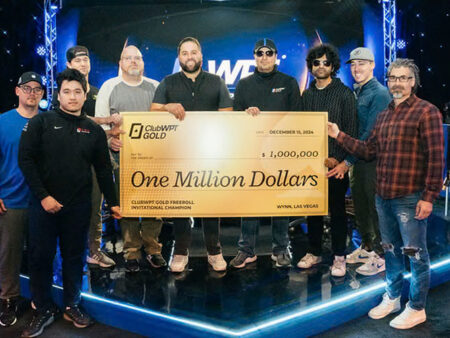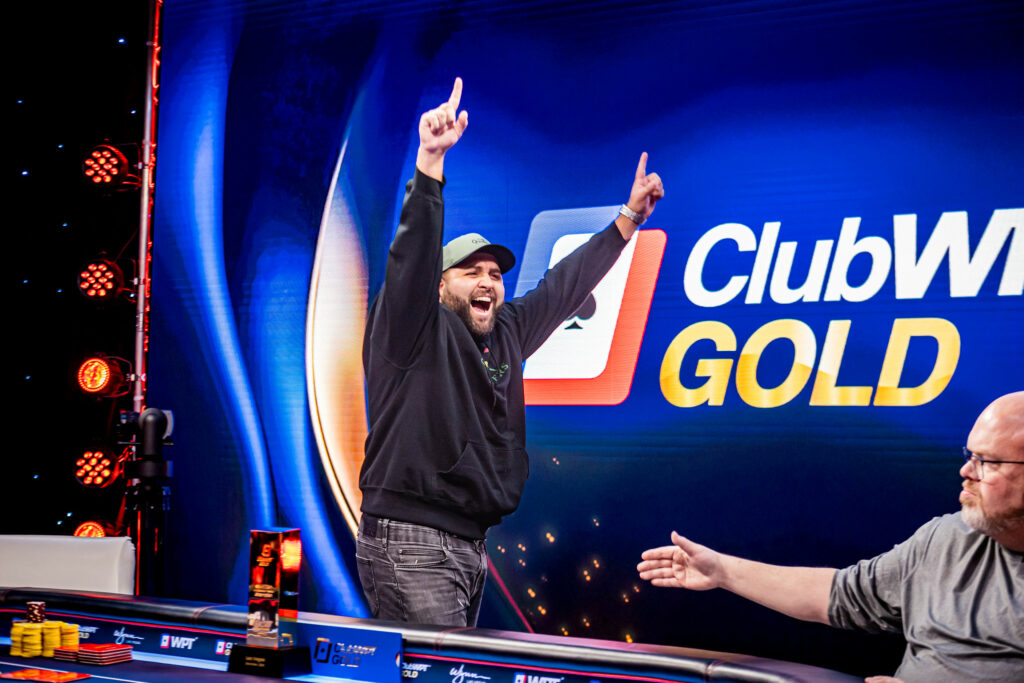
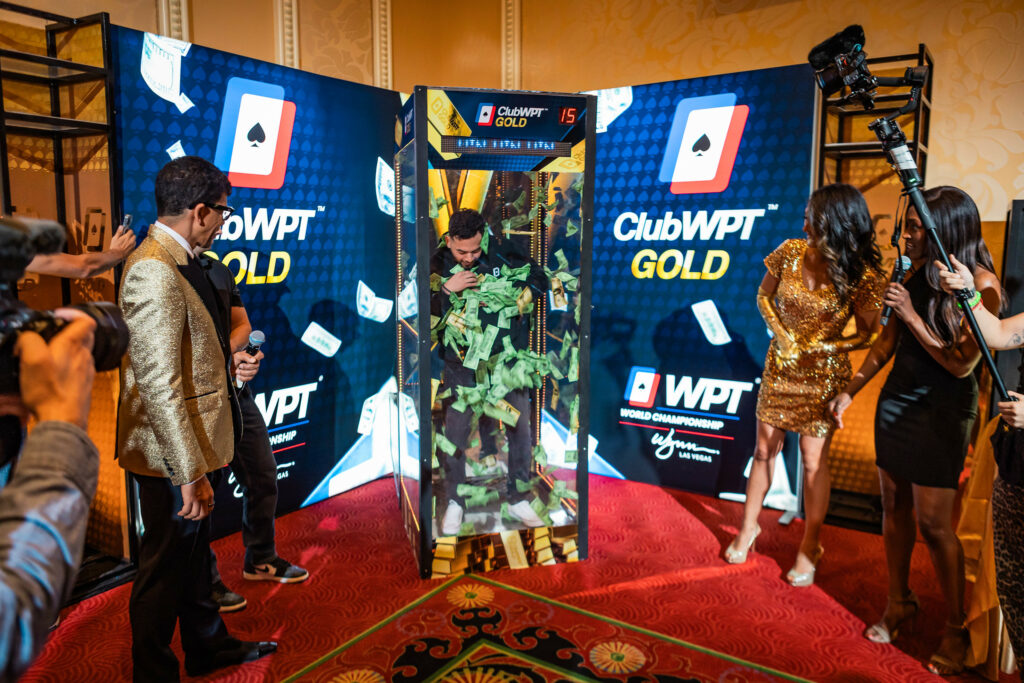
In December 2024, Chase Bricker won $1,110,000 at the ClubWPT Gold Invitational Freeroll at Wynn Las Vegas. The event drew 1,457 players. Every one of them entered for free. Bricker pocketed $1,000,000, Jason Christopher took $250,000 for runner-up, and mystery bounties worth up to $200,000 were in play at the final table. The whole thing ran on a sweepstakes model, with no buy-in, at one of the most prestigious casino addresses in the world.
This December, the same venue will host a $400 buy-in Super Gold Million with a $3,000,000 guarantee, and ClubWPT Gold is adding another $1,000,000 in mystery bounty cash on top of the $10,400 WPT World Championship prize pool. The model was supposed to be dead by now. It isn’t.
What happened in between is the fastest-moving legal story in poker since Black Friday, and one that has split along a line nobody fully anticipated. Sweepstakes casinos had a brutal 2026: eleven states legislated against the model, the biggest operator paid $8 million to settle with New York, and LuckyLand Slots shut down permanently. Sweepstakes poker, which runs on the same legal theory but a different structure, fared considerably better. One state explicitly carved it out of its ban. Another banned it by name. The gap between those two outcomes is where the story lives.


The State of the Model Before 2026
To understand what happened in 2026, it helps to understand what the sweepstakes model is and why it had become a target. Sweepstakes casinos and poker rooms operate on a dual-currency system: players buy Gold Coins with real money and receive Sweeps Coins as a promotional gift. Players can redeem Sweeps Coins for cash prizes. The legal theory is that players are not buying a chance to win.
They are buying Gold Coins and receiving Sweeps Coins free, making the arrangement a promotional sweepstakes rather than gambling. Operators argued they were governed by marketing law, not gaming law. Our December 2025 piece on Stake Poker explains the dual-currency model in practice.
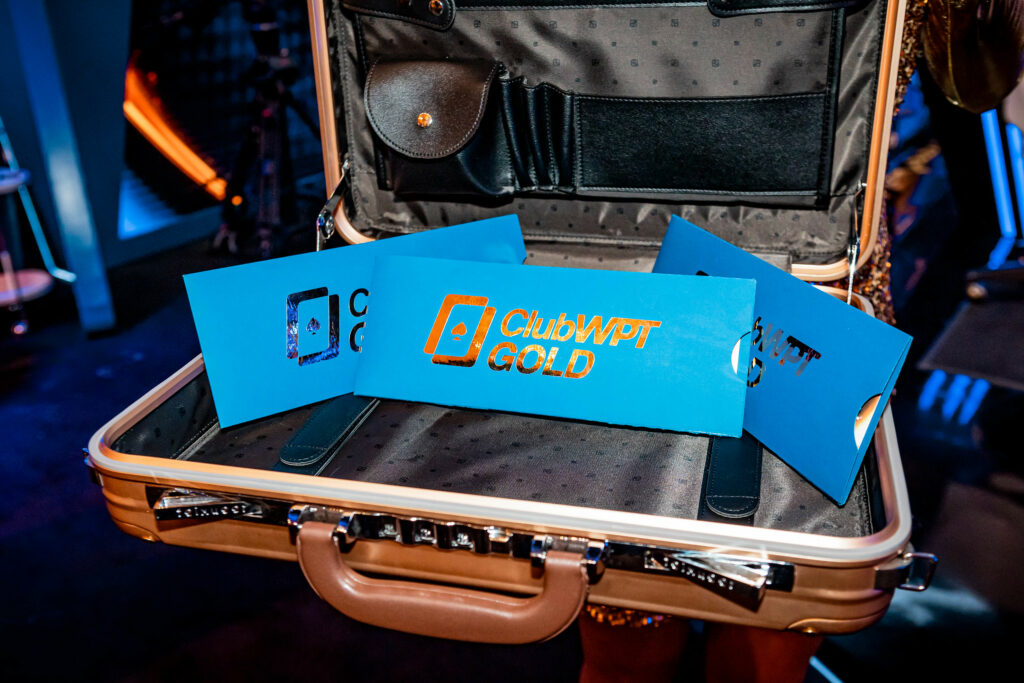
For most of the 2010s and early 2020s, the model ran largely unchallenged. Global Poker launched in 2016. ClubWPT Gold launched in late 2024. By 2024, Eilers and Krejcik Gaming estimated sweepstakes casinos generated $10 billion in national sales, with New York’s market alone accounting for roughly $762 million.
That scale drew regulatory attention. When the enforcement wave hit in 2025, it hit hard. Class actions accumulated. Cease-and-desist letters went out by the dozens. Pragmatic Play exited the US sweepstakes segment entirely. By the end of 2025, five states had passed legislation against the model, and operators had withdrawn from many more.
State by State: The Full Legislative Picture
What follows is every state that acted, by law, by enforcement, or by failed attempt, and where each stands now. The picture is more complicated than the headline count suggests.
Montana: First in the Country
Montana’s SB 555, effective October 1, 2025, was the first state law in the country to target the sweepstakes model. Its scope is broad and its drafting deliberately opaque: the word “sweepstakes” never appears in the bill. Penalties run up to 10 years and $50,000 in fines.
Montana offered no legislative debate worth summarizing. It moved quickly, and operators left. Montana is also one of the few states where the ban explicitly exposes players, not just operators, to misdemeanor charges. Montana has no licensed online poker or casino market as an alternative, leaving players with no regulated option and no sweepstakes option. The offshore sites fill that gap.
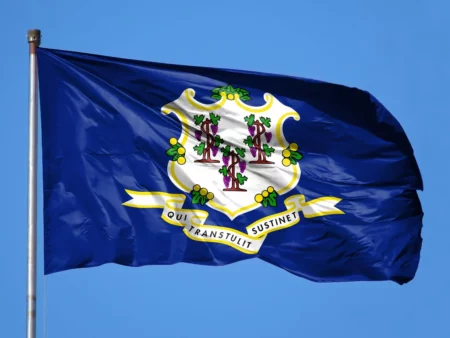
Connecticut
Connecticut’s SB 1235 took effect alongside Montana on October 1, 2025, passing both chambers unanimously, 146-0 in the House, 36-0 in the Senate. The state’s existing tribal gaming compacts gave its legislature additional motivation to act: online sweepstakes platforms were competing with Mohegan Sun and Foxwoods without contributing to the tribal revenue-sharing framework those casinos operate under.
Every dual-currency operator withdrew before the deadline. Connecticut does have licensed real-money online casino gaming through DraftKings (partnered with Foxwoods) and FanDuel (partnered with Mohegan Sun), so players have a regulated alternative for casino gaming. Neither licensed operator offers online poker, and as of 2026, no active sweepstakes poker sites operate in the state. The ban carries Class D felony penalties of up to five years and a $5,000 fine.
Nevada
Nevada’s SB 256, effective October 1, 2025, is worth reading carefully because it does not say “sweepstakes.” Like Montana’s bill, it works through Nevada’s existing unlicensed gambling statutes, broadening their application to catch dual-currency platforms without naming the model. Penalties run up to 10 years and $50,000 per offense, with extraterritorial liability for out-of-state operators. Every major sweepstakes operator now blocks Nevada residents. Courts have not yet answered whether this approach is more or less durable than explicit sweepstakes bans. Nevada has its own licensed online poker market through WSOP.com as part of the MSIGA, so poker players have a regulated alternative. That makes Nevada the only state on this list where that is true.


New Jersey
We covered New Jersey’s A5447 in July 2025 as it waited for the Governor’s signature. Gov. Phil Murphy signed it on August 15, 2025. The Assembly voted 69-10; the Senate voted 34-5. Adam Pliska, WPT CEO, had testified to New Jersey legislators in June that WPT had operated a sweepstakes product for over 15 years without a single issue, lawsuit, or cease-and-desist, and proposed caps and limits as an alternative to prohibition.
New Jersey banned it anyway, with effectively no floor debate. For players, New Jersey is one of the better-served states in the country for regulated alternatives: PokerStars NJ, WSOP Online, BetMGM Poker and BetRivers Poker all operate there, and the state is part of the MSIGA shared liquidity network. Sweepstakes losses matter less in New Jersey than anywhere else on this list.
New York
New York’s S5935, signed by Gov. Kathy Hochul on December 5, 2025, takes effect immediately and is the broadest statute in the country. It extends beyond operators to payment processors, geolocation providers, content suppliers, and media affiliates, with penalties of $10,000 to $100,000 per violation. The scope was deliberate. New York wanted to make the model commercially unviable, not just technically illegal.
New York’s AG Letitia James had already sent 26 cease-and-desist letters on June 6, 2025, with Global Poker among the recipients, months before the law was signed. VGW had exited New York’s sweepstakes market by August 2, 2025. The law codified what enforcement had already achieved. ClubWPT Gold re-entered New York in January 2026 under its new Hand Analysis model, arguing that the restructured product does not constitute a dual-currency sweepstakes platform. The AG has not yet moved against it under that model. New York has no licensed online poker market; for most poker players in the state, ClubWPT Gold is now the only regulated-adjacent option.
California
We covered California’s AB 831 in June 2025, when it was introduced. Gov. Gavin Newsom signed it on October 11, 2025. It took effect January 1, 2026. California was roughly 20% of total US sweepstakes revenue. Its loss to the sector was not incidental. VGW exited entirely. ClubWPT Gold stayed under a “California Game Days” model, limiting players to nine real-money play days per month.
The legal argument is that players who use the hand analysis product are not subject to the sweepstakes ban. California has no licensed online poker market; the state has repeatedly failed to pass online poker legislation despite being the largest potential market in the country. ClubWPT Gold is the only viable online poker option for most California players, operating under a model whose legal durability has not been tested in court.
Indiana and the Poker Carve-Out
Gov. Mike Braun signed Indiana HB 1052 on March 12, 2026, making Indiana the first state to act in 2026. The ban targets the dual-currency casino model and carries civil penalties of up to $100,000. But Sen. Kyle Walker amended the bill in February to explicitly exempt “peer-to-peer skill-based poker games.”
The final statute states plainly that the ban does not apply to these games. This is the most poker-relevant legal development of the year, and we cover it separately below. For players today: sweepstakes casinos have exited Indiana; sweepstakes poker rooms, including Global Poker, ClubWPT Gold, and Clubs Poker, are expected to remain available. Indiana has no licensed online casino or online poker market.
Maine
Gov. Janet Mills signed Maine LD 2007 in April 2026, effective mid-July, alongside a tribal iGaming legalization bill. Violations carry fines of up to $100,000 and permanent licensing ineligibility.
Maine’s language explicitly covers “sweepstakes casinos, sportsbooks, and poker sites”; unlike Indiana, it made no distinction between casino and poker formats. Around 60 operators were active in the state when the law passed. The exit was near-total.
Tennessee
Gov. Bill Lee signed HB 1885/SB 2136 on May 22, 2026, on the last possible day of the signing window. The bill explicitly covers video poker, one of the few statutes to name that format specifically. Tennessee had already issued roughly 40 cease-and-desist letters in December 2025 before any law existed, so the statute codified existing enforcement posture.
AG Jonathan Skrmetti: “The only thing you can be sure about with an online sweepstakes casino is that it’s going to take your money.” Tennessee has no licensed online gambling market. Players have no regulated alternative, sweepstakes or otherwise.
Oklahoma
Oklahoma’s SB 1589 produced the most politically interesting episode of the legislative year. Gov. Kevin Stitt vetoed it, arguing in his veto message: “This bill is so broad that it criminalizes everyday apps people use for fun. That kind of vague and overbroad approach creates uncertainty for businesses operating in good faith.”
The legislature overrode him (Senate 34-10, House 68-19. The bill is now law, effective November 1, 2026, making violations a Class C felony. IGRA tribal gaming is explicitly carved out. Oklahoma is the one hard future date in the year’s legislative calendar. Enforcement begins November 1.
Louisiana
Louisiana’s HB 883 and HB 53 took effect August 1, 2026. HB 53 is the most aggressive statute in the country on penalties: it makes sweepstakes casino violations a racketeering felony carrying up to 50 years in prison. Louisiana had already issued more than 40 cease-and-desist orders before the laws took effect. HB 53’s racketeering framing is designed to enable asset forfeiture, not just operator fines. Louisiana has no licensed online gambling market. Players have no regulated alternative.
Iowa: Not a Ban
Iowa’s SF 2289, effective July 1, 2026, is frequently grouped with the state bans but is structurally different. It does not prohibit sweepstakes gaming. It arms the Iowa Racing and Gaming Commission with cease-and-desist authority.
The distinction matters: Iowa can now act without legislation every time a new operator launches, rather than having to return to the statehouse. For players today, sweepstakes platforms continue to operate in Iowa unless and until the regulator issues a specific order. Iowa has no licensed online gambling market.
Florida
Florida did not pass a sweepstakes ban in 2026. The bill failed in the legislature. But AG James Uthmeier filed suit against VGW in August (Hillsborough County, penalties to $15,000 per willful violation) using existing law. His office’s framing: “If it looks like a casino, takes real money like a casino, and pays out like a casino, it is a casino, and it is illegal under Florida law.”
The complaint itself opens with the duck test: if it looks, swims, and quacks like a duck, it’s a duck. For players today, Florida sits in a grey zone: no sweepstakes-specific statute exists, but an active AG lawsuit against VGW is in progress and Florida law limits sweepstakes redemptions to $5,000 per month. Most major platforms continue to serve Florida players. The legislative ban that failed in 2026 will almost certainly return in 2027.
States That Tried and Failed in 2026
Anti-sweeps bills failed in 2026 in Hawaii, Maryland, Massachusetts, Minnesota, Mississippi and Virginia. Minnesota’s SF 4474 came closest, passing the Senate 30-4 on April 30 before dying in a House committee when the session ended. For players in these states, sweepstakes platforms currently remain available. These failures matter as much as the successes.
The model remains politically viable in roughly three-quarters of US states, and states that failed to pass bans in 2026 can try again in 2027. Minnesota in particular is viewed as a near-certainty to pass legislation next session given the Senate vote margin.
Enforcement Without Legislation
The legislative count understates the total pressure. Operators withdrew from states that sent enforcement letters with no law behind them: Louisiana’s 40-plus orders, West Virginia’s 47 subpoenas, Delaware, Maryland, and Kentucky all pushed operators out before or without any statute. Over 100 class actions were filed nationwide in 2025, with VGW named in more than 20. Depending on how you count Nevada’s unlicensed-gambling statute and Iowa’s regulator-empowerment law, between eight and twelve states have acted by legislation, and operators have withdrawn from considerably more.


Indiana Banned Sweepstakes Casinos. It Did Not Ban Poker.
This is the most poker-relevant legal development of 2026, and the legal trade press has almost entirely missed it.
Sen. Kyle Walker amended Indiana HB 1052 in February to exempt “peer-to-peer skill-based poker games” from the sweepstakes definition. The final bill, signed March 12, explicitly states that the ban does not apply to these games. The named beneficiaries are Global Poker, ClubWPT Gold, and Clubs Poker. They were expected to continue operating in the state. The operators that left Indiana when the ban took effect on July 1 were sweepstakes casino platforms: Modo.us, ACE Casino, Mega Bonanza, Jackpota, McLuck, Hello Millions, PlayFame, SpinBlitz, Baba, Ruby Sweeps, Pulsz Casino and Pulsz Bingo. No poker rooms appear on those exit lists. Walker’s own articulation of the distinction is as clean as it gets: “A sweepstakes game is a chance-based game; it’s the player versus the house. Peer-to-peer poker is a skill-based game and it is player versus player.”
InfoLawGroup’s specialist survey of the 2026 legislative wave, published July 27, describes the Indiana ban purely as targeting dual-currency casino gaming and does not mention the poker exemption at all. The most poker-relevant provision in a year of sweepstakes legislation is absent from the leading law-firm survey of it.
Maine went the other way. LD 2007 bans sweepstakes operators “explicitly including sweepstakes casinos, sportsbooks, and poker sites.” One state decided poker is different. Another decided it isn’t. That disagreement will matter as courts work through these statutes.
Two Operators, Two Directions
Before explaining how the two largest operators in sweepstakes poker responded to this environment, it helps to understand the model they were operating. The traditional sweepstakes poker model used two currencies: Gold Coins, purchased with real money, and Sweeps Coins, received alongside Gold Coin purchases and redeemable for cash. Players were never technically buying a chance to win. They were buying Gold Coins and receiving Sweeps Coins as a promotional gift.
VGW, the Australian operator behind Chumba Casino, Global Poker and LuckyLand Slots, has been at the center of the enforcement wave. On September 9, New York AG Letitia James secured an $8 million settlement comprising disgorgement, penalties and costs, covering VGW’s operation of all three platforms in New York. VGW does not admit liability under the Assurance of Discontinuance, and James’s office will refrain from prosecuting past conduct. One detail most coverage missed: VGW had already exited New York by August 2, 2025, after receiving a cease-and-desist letter in June. The settlement resolved conduct in a market it had already left. “Online sweepstakes casinos like Chumba Casino, Global Poker, and Luckyland Slots posed a dangerous threat to New Yorkers and their financial and mental health,” James said.
VGW also faces a lawsuit from the Florida AG (August 2026, Hillsborough County, penalties of up to $15,000 per willful violation) and the Kentucky AG (June 17, Franklin Circuit Court). On September 14, LuckyLand Slots closed permanently, ending an eight-year run. A separate VGW product, LuckyLand Casino, launched in December 2025 and continues operating alongside Chumba Casino and Global Poker. Global Poker’s flagship annual series, the Eagle Cup and the Rattlesnake Open, have no verifiable 2026 editions in the poker press. No source has confirmed whether that reflects a strategic pause or cancellation.
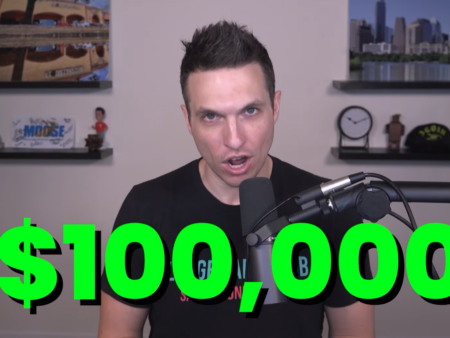
ClubWPT Gold moved earlier and differently. In August 2025, WPT acquired Doug Polk’s Upswing Poker training platform. In September 2025, ClubWPT Gold killed its Gold Coins and Sweeps Coins entirely. Players now buy Hand Analyses, GTO training credits that analyze their in-game hands, and receive Chips with those purchases. Players use Chips to play and can redeem them for cash.
The site repositioned itself as “poker training” rather than sweepstakes gaming. It left New York in July 2025 ahead of the law, then re-entered in January 2026 under the new model. That was one month after New York’s sweepstakes ban took effect. It also remained in California after AB 831 took effect, using a “California Game Days” structure that limits players to nine days per month of real-money play. ClubWPT Gold now operates in both New York and California, the country’s two largest markets, while VGW is out of New York sweepstakes entirely.
In April 2026, ClubWPT Gold ran the Crown Series, $7 million across 33 events. From May 24 through June 28 it ran the Summer of Gold, $50 million guaranteed across five weeks, 76 events, four WPT Championship titles, six consecutive Sunday Gold Millions, scheduled directly opposite the WSOP. Doug Polk, now a ClubWPT Gold ambassador: “It makes sense, I think, when we look at the legal landscape of US poker for Gold to want to transition to something that is a little more sound, a little more defensible.”
The Number That Makes the Case
On March 1, ClubWPT Gold ran a Gold Million with a $1 million guarantee and a 218-Chip buy-in. It drew 11,392 entries, generating a prize pool of 2,278,400 Chips, more than double the guarantee, and the largest tournament in the platform’s history. The top mystery bounty paid $180,000. Polk streamed his run to 15,000-plus viewers and finished 635th.

For context: of the 28 WSOP online bracelet events in 2026, only seven topped $1 million. The largest reached $1,445,850. A sweepstakes Sunday tournament out-drew every WSOP online bracelet event of the year at a fraction of the buy-in. The entire regulated US online poker market, covering New Jersey, Pennsylvania, Michigan, Nevada, Delaware, and West Virginia, produced $95.3 million in revenue in 2025 and $59 million in the first seven months of 2026, with a monthly total of $8 million in May. The sweepstakes market operates in a different order of magnitude, on a different legal footing, reaching players in states where regulated poker does not exist.
The Argument
Adam Pliska, WPT CEO, testified to New Jersey legislators in June 2025 with a pointed defense: “We’ve operated a sweepstakes product for over 15 years. We have never had an issue. We have never had a lawsuit. We’ve never had a cease and desist.” His strongest point for a poker audience is structural: sweepstakes poker allows nationwide competition, while regulated sites are confined to multi-state compacts. WPT’s formal position is regulation rather than prohibition. Pliska proposed caps and limits to give regulators time to observe. New Jersey banned it anyway, 69-10 in the Assembly and 34-5 in the Senate, with effectively no debate on the floor.
On the other side, Professor Bob Jarvis of Nova Southeastern University’s Shepard Broad College of Law was direct about ClubWPT Gold’s California position in January, as reported by Card Player: “Rebranding itself as a ‘poker training site’ is just a meaningless nomenclature change that any court will easily see through. I do not think it’s even a close or debatable argument, and I have no doubt that the courts will rule against ClubWPT Gold.” Card Player, which reported his comments, noted that ClubWPT Gold did not respond directly to Jarvis. The company’s position is simply that the structural changes shield it from the statute.
Both arguments are genuinely held. Neither has been tested in court. Until they are, the model’s legal status depends on which state’s legislature you’re asking, what year you’re asking, and whether their bill said “poker sites” or didn’t.
December at Wynn
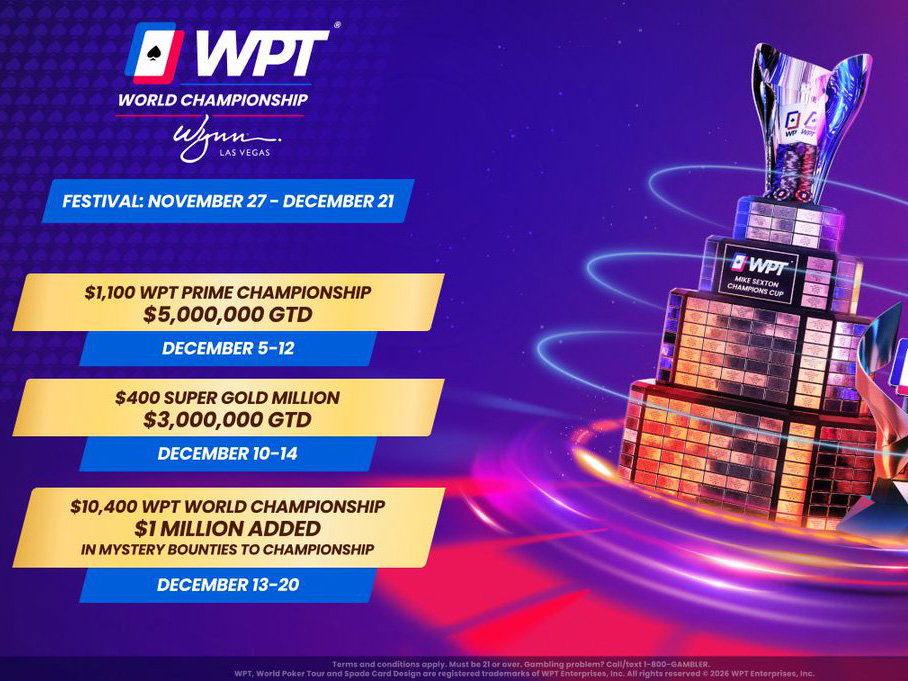
The $400 buy-in Super Gold Million runs December 10–14 at Wynn Las Vegas: four flights, unlimited re-entry, $3,000,000 guaranteed, mystery bounty format. It is the lowest buy-in in the festival’s 85-event schedule and carries the third-largest guarantee. WPT executive tour director Matt Savage confirmed it is exclusively a live tournament, a physical spinoff of the online Gold Million at triple the guarantee.
ClubWPT Gold is also adding $1,000,000 in mystery bounty cash and prizes, separately and in addition to the player-generated prize pool, to the $10,400 WPT World Championship itself, which runs December 13–20. Both were confirmed in WPT’s own release. Our coverage of the mystery bounty add is here: WPT World Championship 2026: $1,000,000 Mystery Bounty Added at Wynn Las Vegas.
Two years ago, Chase Bricker won $1,000,000 at the same venue without paying an entry fee. In December, the model will have a $400 front door, a $3,000,000 guarantee, and a sponsorship position at the richest festival on the American calendar. Eleven states legislated against it in between. The bill was aimed at sweepstakes casinos. For sweepstakes poker, the bill is still being argued over.
FAQ
Article originally produced at poker.pro.